


Barcelona currently has 19 free-use walls where anyone can paint without asking permission, without booking a slot and without submitting a proposal. In 2005 a municipal by-law banned it outright, with fines of 600 to 3,000 euros. This page explains how the city got from one to the other over fourteen years, through three successive platforms: Persianes Lliures, Murs Lliures and Wallspot.
If what you want is to paint today: the list of Barcelona’s 19 open walls, by district, is at the end of this page.
On this page: the starting point · Persianes Lliures · Murs Lliures · Wallspot · Murs Oberts · where to paint today · everything that was done · the map · how it applies to another town
Fourteen years in one table
The whole process comes down to a single thing: the gradual disappearance of the paperwork. This is the map of what the rest of the page explains.
Scroll the table →
| Years | Who authorises | What you had to submit | When you could paint |
|---|---|---|---|
| 2005-2010 | Nobody: banned | — | Never (fine of 600 to 3,000 €) |
| 2010-2011 | The shopkeeper | Nothing | Instantly |
| 2011-2012 | The City Council | A design proposal + the neighbourhood’s colour range | After 6 months, and only on 15 % of the surface |
| 2012-2016 | The City Council, via a managing body | Nothing | Instantly (downloadable permit) |
| 2016-2024 | Platform, on a wall made available | Nothing | Instantly (booking of up to 3 days) |
| 2023-today | Nobody: the code of conduct is enough | Nothing | Instantly |
The path, in four steps
Each phase solves the problem the previous one left open.
The sources for this article are on video. In 2018, at the «Murs Lliures» exhibition at the Centre Cultural Albareda, the people behind the project explained it from start to finish in a public talk. Throughout the text there are links to the exact minute of each point. The talks are in Catalan.
 The history of Barcelona’s legal wallsFull talk at the Centre Cultural Albareda (2018) · 56 min
The starting point: a ban with no alternative (2005-2010)
Barcelona’s by-law on measures to promote and guarantee civic coexistence in public space was approved in 2005 and came into force in early 2006. It banned painting in public space and set fines of 600 to 3,000 euros ▶ min 4:35.
The ban was comprehensive, but it came with no alternative. That had three effects on the practice ▶ min 2:45:
- Geographic displacement. Anyone who wanted to paint properly went out to the dry riverbeds and industrial estates of neighbouring towns — Sant Boi, Sant Just: places where you bother nobody, but where nobody sees you either.
- Time displacement. Those who could not travel painted close to home, at night and fast.
- Worse visible results. Less time and more risk means a less worked piece. The ban did not reduce painting: it lowered its average quality.
A news report from those years put it the same way: «since Barcelona banned painting in the street, the people who do it had moved away» ▶ TV3.
The problem was not the willingness to paint, but that no space existed where it could be done legally.
Phase 12010-2012Persianes Lliures
What it was
An exchange system between shopkeepers and urban artists. The shop owner offered up the shutter of their business; an artist painted it for free, with whatever they wanted and with no aesthetic brief. The shop got a shutter in good condition and free of tags; the artist got a highly visible surface to paint on in daylight, with time and no risk of a fine.
Rebobinart acted as the intermediary and provided the system: a website where shopkeepers registered their shutter and where artists could see which ones were available, pick one and download the permit signed by the owner before turning up. Nobody was paid: not the artist, not the shop, not the organisation.
The visible result was a street that kept changing: in the Guinardó neighbourhood, the shutters on the scheme were repainted every month ▶ TV, 2010. Television described it as «an exchange of favours between shopkeepers and graffiti writers» ▶ TV, Guinardó.
It worked in Horta-Guinardó, grew to 77 shutters, and had a single-day mass edition in Malasaña (Madrid). It was also applied outside retail: municipal markets, social centres, a healthcare facility and a prison.

The problem it solved: no legal surface was available
It started from a domestic fact —one of the founders painted graffiti and was piling up fines he could not pay— and a practical question: if the wall is private and the owner agrees, what is stopping us? El Periódico covered the origin story in 2024.
Shop shutters met three useful conditions: they are private, they are highly visible, and they were in poor shape, so the shopkeeper got something out of it.
| Surface | Shutters voluntarily offered by the shopkeeper |
|---|---|
| Permission | Written authorisation from the owner, not from the administration |
| Access | A website with the listing; the artist registered and downloaded the signed permit ▶ min 9:47 |
| Cost | None, for the artist or the shop |
| Legal basis | The by-law did not define where the public façade ended and private space began ▶ min 8:17. That gap was the opening |
What it proved
- Demand on both sides. From the initial 22 shutters ▶ min 9:03 it grew to 77 ▶ min 10:08, and within a few months there was no need to go door to door: the shopkeepers were calling.
- It could scale to another city. On 6 February 2011, in Malasaña and together with the local paper Somos Malasaña, around 140 shutters offered by 72 shops were painted in a single day by more than a hundred artists (El País), documented one by one. Artists came from London and Bristol ▶ min 10:33, and the Madrid festival Pinta Malasaña acknowledges it as its origin.
- That a well-documented private permit functionally replaces an administrative one… as long as the administration does not legislate against it.
It also made clear that opening up a free space has a cost for somebody: there were people making a living painting shop shutters, and part of the scene responded by painting over the work at night ▶ min 11:03.
 Pau Garcia on Persianes LliuresHow it all started, first-hand · 19 min
Why it ended
In 2011 the city’s Urban Landscape Institute brought shutters inside the definition of the public façade. The new conditions ▶ min 12:59: only 15 % of the surface could be freely painted, the rest had to match the neighbourhood’s colour range, a six-month procedure was required, and the fine now extended to the shop that allowed it.
The lesson carried into the next phase: exploiting a gap in a by-law works once. To make it last, the permission had to be public, explicit and immediate.
The interlude that refined the method (2011-2012)
Activity shifted to spaces where permission was not the obstacle: a shelter for homeless people, the Castelldefels market, the perimeter wall of a healthcare facility in Sant Boi —300 metres, painted with neighbours and service users before demolition—, the P-Art festival ▶ TV and the Quatre Camins prison: «the exact opposite of a free wall; it was a closed wall» ▶ min 15:26.
These projects did not solve the legal problem, but they contributed what would later be half the model: the intervention is not made by an artist alone; it is made with the community that uses the space.

Phase 22012-2016Murs Lliures
What it was
A network of municipal walls made available by the City Council so they could be painted legally, managed by Rebobinart. The change from the shutters is one of ownership: these are no longer private walls but public space opened up by agreement with the district.
How it worked, for anyone who wanted to paint:
- You registered on the website —and, from 2014, on the mobile app.
- You chose which wall and which day.
- You downloaded the permit instantly, with no sketch or proposal to submit.
- You went and painted, in daylight and with the permit on you.
- You photographed the piece and uploaded it: each wall built up its own record of interventions.
The works were ephemeral and rotating: after a while, the wall opened up again. There was no filter —not of quality, not of track record, not of content: a veteran writer, an illustrator who had never painted outdoors or a neighbour could all use it.
It began with a single wall —the Tres Xemeneies gardens, on 28 October 2012— and spread to Sant Martí and Sant Andreu, with close to 600 registered artists in the first year alone.
The problem it solved: opening up public space without anyone taking it over
In January 2012 the association was set up to negotiate the handover. Roger Pous drafted its terms and describes the negotiation: one year, four consecutive levels —mayor’s office, district, neighbourhood technical staff and the administrative officers—, each with the power to block it. The initial obstacle was not about planning but about definitions: the first discussion was whether graffiti is art at all ▶ min 3:10.
 Roger Pous on negotiating with the City CouncilFour levels, one year and the permit with no sketch · 10 min
The five design decisions
1. Whoever manages the wall does not paint on it ▶ min 0:40. Other collectives had obtained legal walls elsewhere, and the usual pattern was that they became that collective’s wall. «Since we did not want to paint, we wanted to open the walls to everyone.» It had a cost: the organisation sat between two camps —too much of an outsider for the scene, too much of a writer for the administration— ▶ min 2:24.
2. No quality or track-record filter. This is the decision that widened the user base well beyond graffiti, and the one the artistic direction would later defend through Kant: if there is no universal canon of beauty, nobody can decide who deserves a wall ▶ min 38:53.
3. Immediate permit, no sketch ▶ min 6:43. The existing municipal permit required a sketch of the work and a justification, and took weeks or months: incompatible with the practice, and a form of prior content control.
4. Systematic documentation. Visibility for an ephemeral work, traceability for the administration.
5. Social groundwork before any wall ▶ min 7:33. Three or four hundred meetings in a year with residents’ associations, local organisations and schools ▶ min 37:17. A free wall without the neighbourhood behind it becomes a local conflict at the first complaint.

Outcome
On 28 October 2012 Barcelona’s first legal wall opened: «just one wall, but a legendary one» ▶ min 8:29. Television was there ▶ min 1:15:
It democratises art. It makes no difference whether you are Dalí or you or me. There is no better gallery than a city.Television report, 28 October 2012
 «There is no better gallery than a city»Television report from the day the first wall opened, 28.10.2012
There were around 600 registered writers, and the City Council attached an explicit condition: it was a pilot project and, if it worked, expanding it would be considered ▶ min 1:53. The next day, La Vanguardia ran the headline «Graffiti with permission». That same year the project was recognised at the BDigital Innovation Awards, in the innovative ideas and pilot projects category ▶ video.
The pilot expanded to Sant Martí in 2013, where the available space allowed it to move much faster ▶ min 8:41, and to Sant Andreu in 2017.
The main effect was on who took part: people who had never painted outdoors started doing it. Visual artist Enric Font explained it in 2014 ▶ min 1:32:
I had never painted in the street until I started going through the app.Enric Font, visual artist
More in his interview and in Núria Toll’s. Many more women also came in. The assessment at the time was cautious: «it is not an easy city… but it is all a process» ▶ min 0:56. In 2015 the project received Barcelona Activa’s Social Entrepreneurship Award ▶ TV2, min 2:45.

Phase 32016-2024Wallspot
What it was
The same system turned into an international platform. Wallspot was not a single-city project: it was the tool that let any wall owner —a city council, a company, an organisation, in any country— make it publicly available, and let any registered artist use it.
- The owner registered the wall, with its conditions of use.
- The artist booked it and obtained a licence of up to three days.
- They painted, and uploaded a photograph of the work.
- Each wall had its own public geolocated gallery, with every layer painted over the years.
It was, at once, a permit management system and an archive: the memory of an art form that by definition disappears. Photographers had a role of their own, not an ancillary one.
- 106walls in 22 cities
- 33,000documented interventions
- 22,000registered users
- 12Wall Labs

The problem it solved: the model worked in one city and was not exportable
Murs Lliures was a local agreement with permits handled manually. It had to become infrastructure. Wallspot was born in October 2016, designed by Huaman Studio; Domestika called it «the Airbnb of urban art» —a comparison the founders had already used back in 2010 for the shutters ▶ min 9:47— and in February 2017 VICE gave it its international launch.
The underlying change: permission stops being requested
Under Murs Lliures, each intervention was authorised one by one: the wall was available, but the artist requested a permit for a specific day. With Wallspot the process on the website is practically the same, and yet it comes to be called something else ▶ min 5:26:
Before, artists asked for permission on the website; now they make a booking on the website. Painting the city of Barcelona is legal in certain spaces, but now we call it a booking.Marc Garcia, Centre Cultural Albareda, 2018
It is a change of vocabulary, and that is precisely why it matters: booking only makes sense once the space is already designated for that purpose. Nobody asks permission to use a municipal tennis court; they book an hour. Once the wall stops being an exception authorised case by case and becomes a standing facility, the process stops being an authorisation and becomes scheduling.
The clearest image of it came in December 2016, painting the inner walls of the Sant Andreu football ground ▶ min 0:38:
We always say this is the bike lane. We have built the bike lane of art. Anyone can come here and paint whatever they want. These spaces may last a week, a month or a year, but you know your work will eventually disappear.Marc Garcia, December 2016
 «We have built the bike lane of art»The walls at the Sant Andreu ground, December 2016
Both halves of the sentence are the whole model: a bike lane is always there, it does not assess who rides on it, and what happens on it does not stay.
Programming the wall, not just opening it
An open wall with no programming tends towards saturation and repetition. From December 2018 the system was complemented with four formats:
| Format | What it solves |
|---|---|
| Wall Labs | Spaces handed to an artist or collective for a whole year: they allow long-lasting work, which rotation prevents — EINA, Anna Taratiel, Roc Blackblock, Mina and Kenor, La Model |
| Themed JAMs | A social organisation proposes the theme and two guest artists select between eight and twelve creators — Writers, Block, Wild Life, LGBTIQ+, Migration |
| Wall Claim | Advocacy commissions on a specific wall |
| Travel the Wall | An open call that brings an artist from elsewhere to paint in the city |
The platform’s own data produced a finding that opened up a separate strand of work: 96 % of those booking a wall were men. Womart came out of that.
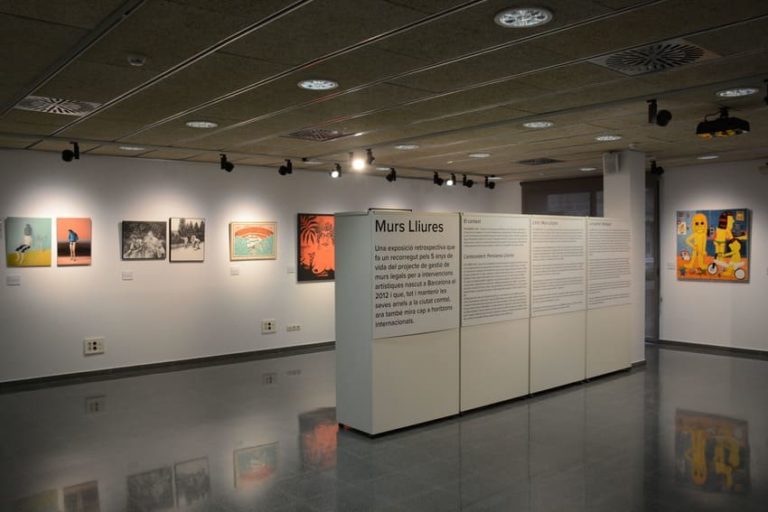
The model was exported to Madrid (2020, Moratalaz and Puente de Vallecas) and Terrassa (2021), and received the Catalan Government’s Civic Award (2018), a grant from the Barcelona Metropolitan Area (2019) and recognition from Spain’s Ministry of Culture (2022). In 2018 there was a retrospective exhibition at the Centre Cultural Albareda —the source of the talk that documents this article— and another at Montana Gallery.

The model’s two limits
- Financial and technical. A platform with an app, a database and a gallery carries permanent maintenance costs out of all proportion to the size of the sector.
- Structural. A free wall provides space, permission and visibility, but no fees. Artists raised that objection from day one and they were right: working for free is sustainable for an experimental space, not as a professional relationship. The answer to that limit is not the free wall but paid commissioned work.
Phase 42023-todayMurs Oberts
In April 2023 the Barcelona Institute of Culture launched Murs Oberts: a municipal network of free-use walls managed directly by the City Council. It started with 14 walls; today there are 19.
| Murs Lliures / Wallspot | Murs Oberts | |
|---|---|---|
| Permission | Immediate, but you had to obtain it | None: just turn up |
| Booking | Yes, by day and wall | No |
| Management | External body under a per-wall agreement | 100 % municipal |
| Boundaries | By agreement with the district | Physical signage fixed to the wall |
| Documentation | Public gallery of every work | None |
| Rules | Platform terms of use | Code of conduct: nothing offensive, sexist, xenophobic or advertising |
| Permanence | Agreed rotation | No guarantee, of duration or upkeep |
| Rights | Retained by the author | Retained by the author (integrity of the work and non-commercial use) |
In September 2024 Wallspot closed: the technology costs were no longer sustainable, the city already had its own tool and the sector had shifted towards commissioned murals and festivals. It was covered by betevé, El Periódico and La Vanguardia.
What is gained and what is lost
Stability is gained. The walls no longer depend on an agreement or on one organisation staying afloat: they are an ordinary municipal facility, the way a skatepark is.
The record is lost. And that can be quantified: over twelve years, Wallspot documented 33,000 interventions with authorship and date. Since 2023, none are documented. Today there is no way to know how many works have been painted on Barcelona’s walls, who made them, or what was on that wall before. The city has gained the infrastructure and lost the memory of what happens on it.
Everything that was done
Twelve years left more than seventy documented actions. This is the full record, grouped by programme: each entry links to its own page with photos, artists and context.
Persianes Lliures (2010-2012)
Shops, markets, social centres and a prison. Seven actions with the same mechanics: a surface made available, a free hand for the artist, no cost.
- Persianes Lliures 2010
- Centre d’acollida Assís 2010
- Mercat de Castelldefels 2010
- Persianes Lliures Madrid 2011
- P-Art Barcelona 2011
- Viu el mur de Sant Boi 2011
- Quatre Camins 2012
Murs Lliures: opening up the city (2012-2017)
From the first wall to the district network, the app and the first awards.
Taking it outside: exhibitions, conferences and showcases
The project as a case study: from Smart City Expo to Google Campus Madrid.
Wall Labs: a wall for a whole year
Twelve editions. The artist has the space for twelve months, which rotation does not allow.
- WALL LAB by EINA 2018
- WALL LAB by Tim Marsh 2019
- WALL LAB by Anna Taratiel 2020
- Wall Lab by SPOGO 2020
- WALL LAB BY Ele.zissou 2020
- WALL LAB BY Borneo Modofoker 2020
- WALL LAB BY Roc Blackblock 2020
- Wall Lab by MINA AND KENOR 2020
- Wall Lab by Bemie 2020
- Wall Lab by Inventura Studio, Zaick, Maru, Eloise Gillow 2020
- Wall Lab by Carola Bagnato , Dirty, Galleta Maria, Pol Pintó 2021
- Wall Lab by Dante Arcade 2022
- Wall Lab La Model 2022
- Wall Lab La Model 2023 2023
JAMs: one theme, one organisation, twelve artists in a day
Intensive creation days. The social organisation sets the theme; two guest artists choose who paints.
- WRITERS JAM 2020
- WOMART JAM 2020
- BLOCK JAM 2020
- EXTICTION JAM 2020
- SPORTS JAM 2020
- WRITERS JAM 2021 2021
- ABSTRACTION JAM 2021
- WOMART JAM 8M 2021
- WILD LIFE JAM 2021
- LOGOART JAM 2021
- REALISM JAM 2021
- Terrassa Walls JAM 2021
- Terrassa Walls x Latent Fest 2021
- WOMART JAM 8M 2022
- LGTBIQ+ JAM WALLSPOT 2022
- JAM MIGRACIÓ WALLSPOT 2022
- IV WOMART JAM 2023
- LGTBIQ+ JAM 2023 2023
Wall Claim and Travel the Wall
Advocacy commissions on a specific wall, and an open call bringing an artist from elsewhere to paint in Barcelona.
The model beyond Barcelona
Madrid (Moratalaz and Puente de Vallecas), Terrassa, and the closing of the Madrid pilot with 56 artists at once.
Activations, training and new walls
Everything that happened on the walls when there was no JAM or Wall Lab.
Where you can legally paint in Barcelona right now
These are the 19 Murs Oberts in the municipal network, by district, as listed today in the Institut de Cultura catalogue. No permit or booking needed. Each wall’s address, photo, directions and the rules are on the practical page: Legal graffiti walls in Barcelona: where to paint today.
- Ciutat Vella (3): Camp de futbol Parc de la Catalana · Passeig de Circumval∙lació · Plaça de Terenci Moix
- Gràcia (3): Jardins de Caterina Albert · Jardins de Manuel Torrente · Travessera de Gràcia 104
- Horta-Guinardó (1): Pas soterrat Velòdrom Horta
- Les Corts (1): Jardins Àurea Cuadrado (General Batet amb Manuel Azaña)
- Nou Barris (1): Ronda de la Guineueta Vella 51
- Sant Andreu (4): Basconia amb Riera Sant Andreu · Estadella amb Santander · Exterior Nau Bostik · Skate Park Baró de Viver
- Sant Martí (2): Aragó amb Bilbao · Doctor Trueta amb Àlaba
- Sants-Montjuïc (4): Jardins Walter Benjamin · Jardins de les Tres Xemeneies · Metal·lúrgia amb Motors · carrer Papin
See all 19 walls with map and photos →
Source: Institut de Cultura de Barcelona (Murs Oberts). Data updated on 12/10/2026.
Map of the 19 walls
Each point is a City Council open wall. Click it for the address and to open it on a map.
The map needs JavaScript to load. The list of all 19 walls, with address, district and neighbourhood, is just above.
We draw this map ourselves from the Barcelona Institute of Culture’s public data: their own page cannot be embedded.
How this applies to another town or city
The model is transferable, and it is what we design for local authorities and institutions. Six minimum components:
- An inventory of surfaces in municipal ownership, or private with consent: perimeter walls, hoardings, underpasses, sports facilities, vacant plots.
- A short, written régime of use: what is allowed, what is not, and who is responsible for what.
- Zero or immediate paperwork. Anything that takes more than a few days switches off real use of the space.
- No prior content control, with limits set by general law rather than by aesthetic judgement.
- Prior agreement with the neighbourhood, its organisations and local facilities.
- Documentation and upkeep: who photographs, who cleans and how often the space reopens.
To explore how it would work in your municipality, see murals for institutions and public art.
The outcome: from exception to ordinary public provision
In fourteen years the city has gone from banning to tolerating, from tolerating to authorising, and from authorising to providing. The walls are no longer an exception somebody has to defend every year: they are part of Barcelona’s ordinary public provision, like a football pitch or a tennis court. That was the goal, and it is the reason the project that pushed for it was no longer needed.
Frequently asked questions
Where can you legally paint in Barcelona?
On the 19 walls in the City Council’s Murs Oberts network, with no permit or booking, respecting its code of conduct. The list is on this page.
Do I need to ask permission or book a slot?
No. Until 2024 you had to book the wall on the platform; now you just turn up.
What happened to the works documented on Wallspot?
The platform closed in September 2024 and the public gallery is no longer accessible. The projects produced by Rebobinart are kept on this website.
Can my municipality have free-use walls?
Yes. The section above sets out the six components. It is one of the services we provide to public authorities.
Does Rebobinart still manage free walls?
No. They have been managed directly by the City Council since 2023. Rebobinart produces murals, community urban art and festivals.
Video archive
- 2018 · 56 minThe history of Barcelona’s legal walls (full talk)
- 2018 · 19 minPau Garcia — Persianes Lliures
- 2018 · 10 minRoger Pous — Murs Lliures
- TV · 2010Persianes Lliures
- TV · 2010Persianes Lliures brings together writers and shopkeepers in the Guinardó
- TV · 2011P-Art, a car park in Les Corts
- 2012BDigital Innovation Awards
- TV · 28.10.2012Opening of the first legal wall
- TV3«Murs lliures» to paint on
- 2014Launch presentation of the Murs Lliures app
- TV · 2014The app goes live
- TV2 · 2015«Tinc una idea» — Barcelona Activa Social Entrepreneurship
- TV · 2016The walls made available in Sant Martí
- TV · 12.2016The Sant Andreu ground and «the bike lane of art»
In the video, the presentation of Murs Lliures as the winning project at the 2012 BDigital Digital Innovation Awards, in the innovative ideas and pilot projects category. It explains how the platform works —register, choose a wall, download the permit, paint and upload the photo— and the plan to extend it to other cities and countries.
In the video, a report on the walls at the Sant Andreu football ground handed over to Murs Lliures. Rebobinart explains the Wallspot app and website, which let anyone request a permit to paint anywhere in Barcelona, and the comparison they always use: «we have built the bike lane of art». One of the artists used to swim at the pool there as a child.
In the video, a report on the P-Art gathering in a car park in Les Corts: close to 80 registered artists covered the wall in about eight hours. The organisers call for more spaces for artists and for breaking the pattern that confines art to galleries: «a message in the street reaches far more people».
In the video, a report on the free walls in Carrer del Perú, in Sant Martí, and at the Espronceda–Marroc junction, managed by Rebobinart. Residents speak —in favour, with reservations— and the report mentions the Murs de l'Escocesa festival, the popular-culture mural in Plaça del Poble Romaní and Roc Blackblock's anti-fascist mural in Carrer del Taulat.
Video transcript (translated from Catalan)1 min 30 s
The reportOn these walls in Carrer del Perú, in Sant Martí, graffiti can be painted with no problem at all: it is one of the spaces the city council hands over to the company Rebobinart to manage. Anyone who wants to create work here, or in other spaces around the city, can do so through a mobile app or on the murslliures.com website, booking a date, a wall and a number of days to work on it.
Another similar space, an example of Barcelona opening up to this kind of street art, is at the junction of Carrer d'Espronceda and Carrer del Marroc. The graffiti coexists with residents, who accept the paintings with some reservations.
Local residentsBetter than having bare walls. I think it's great that they let people do graffiti; and besides, it looks really cool.
Local residentsVery cool. And I take quite a few photos here and they come out well.
Local residentsIf they carry a political ideology, I don't like them, because not everyone shares them.
Local residentsI think the paintings are great, because they are an opportunity for the artists: they are unknown and with these paintings they can make a name for themselves.
The reportThe city also promotes this urban culture with events such as the Murs de l'Escocesa festival, held this July, in which artists decorate places like the old factory complexes.
Besides graffiti turned into art, murals can serve another purpose. In Plaça del Poble Romaní, in Gràcia, three artists depicted the neighbourhood's popular culture with the aim of bringing the square's users together. And in Carrer del Taulat, the artist Roc Blackblock stands up for the anti-fascist struggle.
Video transcript, edited for reading: repetitions and verbal fillers have been removed, the text has been punctuated and speakers are identified.
In the video, the talk marking the project's fifth anniversary at the Albareda cultural centre, with Pau García, Roger Pous and Míriam. It is the story of how things went from paying fines of 600 to 3,000 euros for painting in the street to having legal walls: the civic bylaw, the meeting with Xavier Trias in a bar in Gràcia, the 300 or 400 meetings in a single year, and the first wall, at Tres Xemeneies.
In the video, Pau García's contribution to the talk marking the project's fifth anniversary, which he titled The Backstage Story of Wallspot: how he started painting at thirteen, the civic bylaw and the fines of 600 to 3,000 euros, his brother's idea for paying them, the first shutters in Horta-Guinardó and the separation of the project. The text of this talk is on Legal walls of Barcelona, with all four speakers.
In the video, Roger Pous's contribution to the same talk: why they opened the walls to everyone rather than keeping them, the «yes, but graffiti isn't art» from the first meeting with Urban Landscape, the meeting with Xavier Trias in a bar in Gràcia, and why the project needed a social base in the neighbourhood. The text of this talk is on Legal walls of Barcelona, with all four speakers.
In the video, the TVE Catalonia programme Tinc una idea on social entrepreneurship. Rebobinart appears as the first-prize winner of Barcelona Activa's programme. The text covers their section: the 2006 civic bylaw, the years of fines «until the council saw that our actions were agreed with local residents», and why in Dóna la cara per la ciutat the protagonist is neither the artist nor the work, but the person being painted.
In the video, a TV3 report explains how Poblenou got the smell of spray paint back: the district hands over abandoned walls so artists can paint legally, after municipal by-laws pushed them off the street. The project's promoters speak, and the piece asks whether banning actually works.
In the video, a second, shorter piece on Persianes Lliures in Guinardó: the problem of tagging, the exchange of favours between shopkeepers and graffiti artists, and the 17 shutters handed over, which change colour every month.
In the video, a report on the launch of Persianes Lliures in Guinardó: shopkeepers hand over their shutter, artists paint it for free. Shopkeepers speak —«they take a problem off your hands»— along with graffiti artists, who see a legal outlet after the civility by-law. So far, 17 shutters handed over.
In the video, a television report on the launch of Murs Lliures: the first legal walls at Tres Xemeneies park, the website where permits are requested, and the aim of reaching one wall per district. Rebobinart had close to 600 graffiti artists painting in Barcelona on its books.
In the video, a report on the Murs Lliures app: artist Enric Font requests the permit at the wall itself, checks what has been painted there before and can start a second later. They explain the idea of democratising art, each artist's profile of works, and the plan to reach Lisbon and Paris.
In the video, the app launch party with El Xupet Negre, 25 years after he became a landmark of graffiti: three new walls offering a kilometre of surface, and why painting in Barcelona still isn't easy.
Video without narration: a visual presentation of the Murs Lliures app — choosing the wall, requesting the permit and starting to paint.

