



Catalonia / 2015 – 2023
MURMURS is Rebobinart’s own project, revitalising towns and cities across Catalonia through urban art and collective creation: murals made with and for the community.
The project: MURMURS
MURMURS is a space for cultural creation and social engagement that explores identity and its representations through urban art and participatory community action. It gathers the sounds of new stories and old ones, draws maps of the themes running through a community, and paints murals made with and for the people who live there.
The project first took shape in 2015 on an urban allotment site in the Les Corts neighbourhood of Barcelona, and has since travelled through towns and cities across Catalonia: Santa Maria de Palautordera, Girona, Els Hostalets de Pierola and Malgrat de Mar. Every stop leaves a mural behind, but above all it leaves a process.
How it works: artistic residencies with the community
What sets MURMURS apart is not the wall, but how we get to it. The project creates artistic residencies in which the artist does not arrive with a finished design under their arm, but listens to and talks with local people before painting. There are meetings, talks and participatory sessions both before and after the mural is painted, involving local historians, municipal archives, neighbourhood associations, schools, young people and cultural organisations.
It is a deliberate immersion in the local area, designed to give value to the process and not only to the final result. The content of the wall comes out of that listening: which stories get told, whose faces appear, which memory is claimed. That is why no two MURMURS murals look alike — each community brings its own account.
The projects are driven by town councils together with Rebobinart, and internationally recognised artists are invited to take part: artists who understand urban art as a tool for social transformation and as a channel of communication capable of building links between people.
The MURMURS murals
Urban allotments — Natalia Morales and Octavi Serra. Les Corts, Barcelona · April 2015.
The project’s starting point. A participatory mural on Passatge Felip de Pau, on a site given over to urban allotments, created with the neighbourhood’s community organisations and supported by conflict mediation. The design drew on the collective imagination of the area and incorporated Braille, with the collaboration of the Centre d’Higiene Mental de les Corts, the Associació Discapacitat Visual Catalunya, local residents’ associations and several occupational centres.
El Pont — residents of the Pont Trencat neighbourhood. Santa Maria de Palautordera · 2017.
More than 500 m² painted over a single weekend: the footbridge crossing the C-35 road and the walls of the neighbourhood school. The intervention grew out of years of local campaigning for a safe way to cross the road, and it was the community itself that decided how the surface would be treated and what it would depict.
Arts i Barris — Perrine Honoré. Pla de Palau-Sant Pau, Girona · October 2020.
An artistic intervention on the Carrer Migdia facade of the Pla de Palau community centre, part of the Arts i Barris project. The aim was to encourage neighbourly coexistence and to underline the identity of the area, based on participatory sessions in which the neighbourhood residents’ association took an active part.
Urban art workshop — Perrine Honoré. Els Hostalets de Pierola · May 2022.
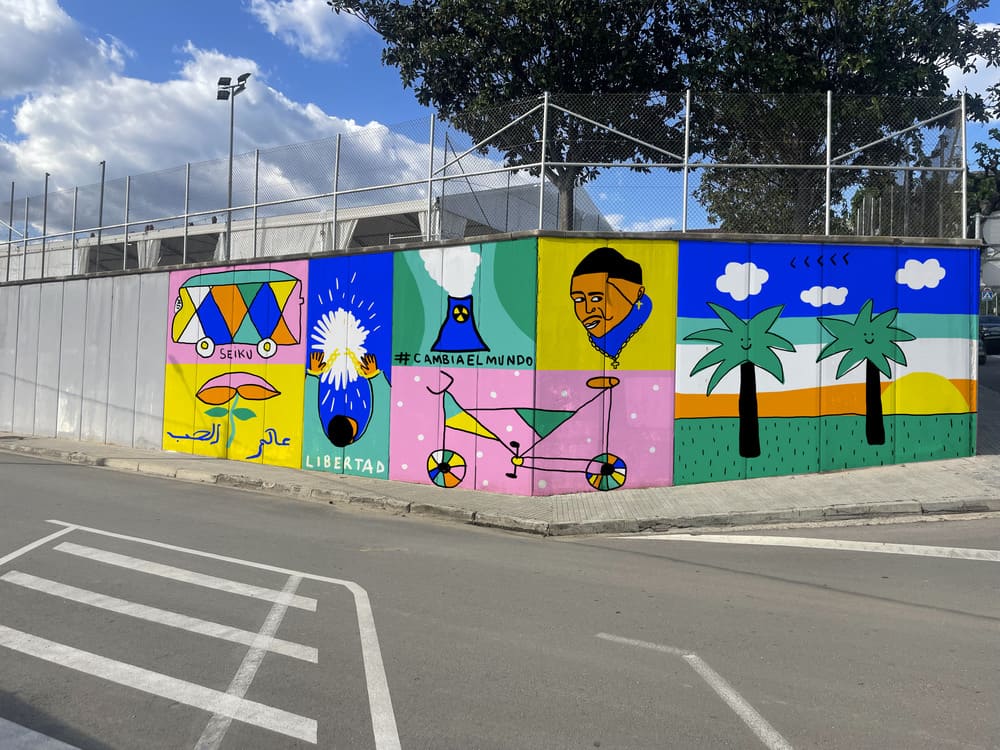
A workshop at the Can Gras centre for unaccompanied migrant minors, opened in 2020. Over two intensive sessions, a group of young people from the centre developed and painted the design together with the French muralist and illustrator. The centre was working to stop being an isolated transit space and to open a dialogue with the surrounding neighbourhood.
Neus Català — Miquel Wert. Malgrat de Mar · 2022.
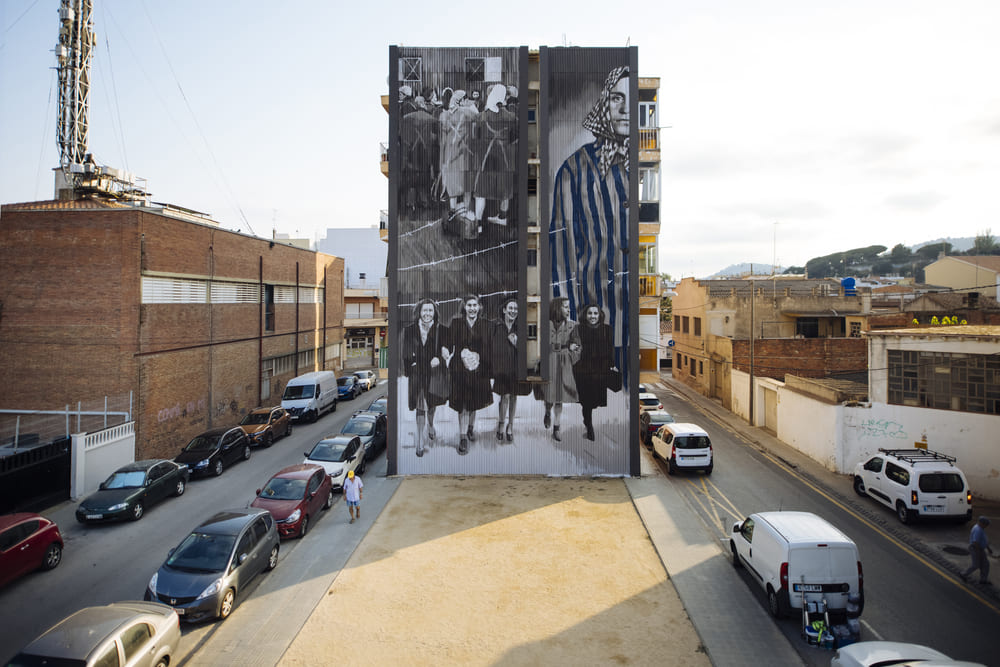
A large-format mural dedicated to Neus Català, a republican and feminist who devoted her life to fighting fascism and defending historical memory. Exiled by the Franco dictatorship, she joined the resistance in France; she was arrested, sentenced to life imprisonment and deported to the Nazi concentration camp of Ravensbrück. The work brings together moments from her life and turns them into a cry of hope.
Neus Català — Núria Toll with eleven local young people. Malgrat de Mar · July 2022.
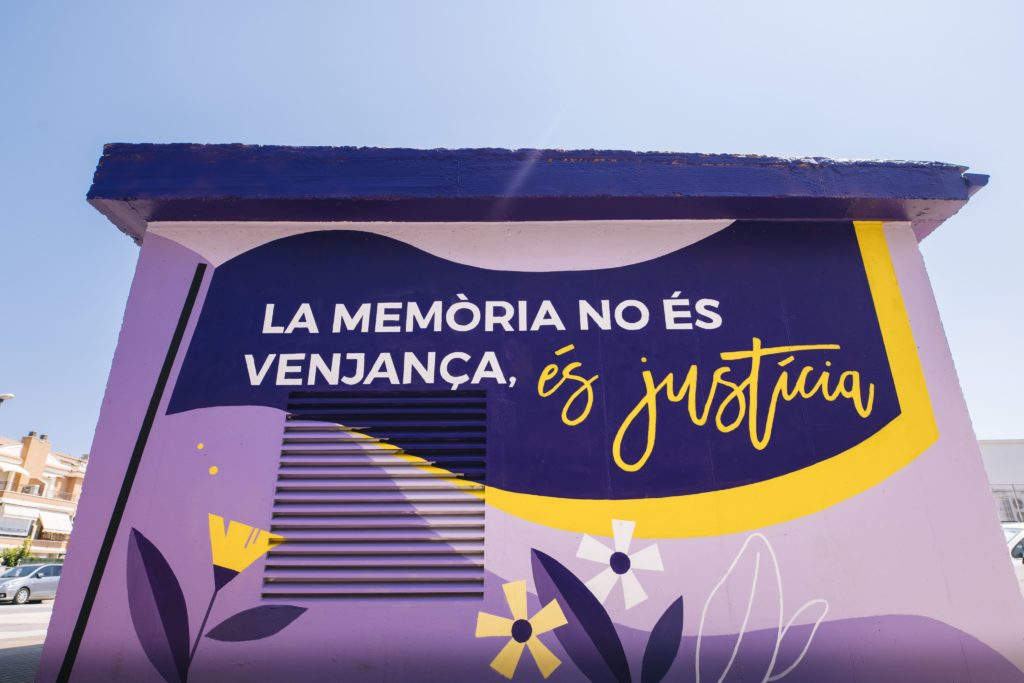
The younger face of the same story. As part of the Juliol Jove programme, and following awareness sessions led by local historian Sònia Garangou, eleven young people designed and painted a mural on an electrical substation hut. The process introduced them to the figure and legacy of Neus Català while building cooperation and teamwork, using muralism as a means of expression.
Dona i pagesia — Mohamed L’Ghacham. Malgrat de Mar · 2022.
A large-format mural on the walls of the former Farmers’ Union building. It shows a middle-aged woman — nearly 10 metres tall, framed in a low-angle medium shot — picking olives, alongside a greenhouse crop: the two most widespread forms of farming in Catalonia. The process brought together journalist Laura Saula, six women farmers from the town, two municipal archivists and twelve students from the agricultural programme at Institut Ramon Turró i Darder.
La Verneda i el Castell — Núria Riba. Malgrat de Mar · 2023.
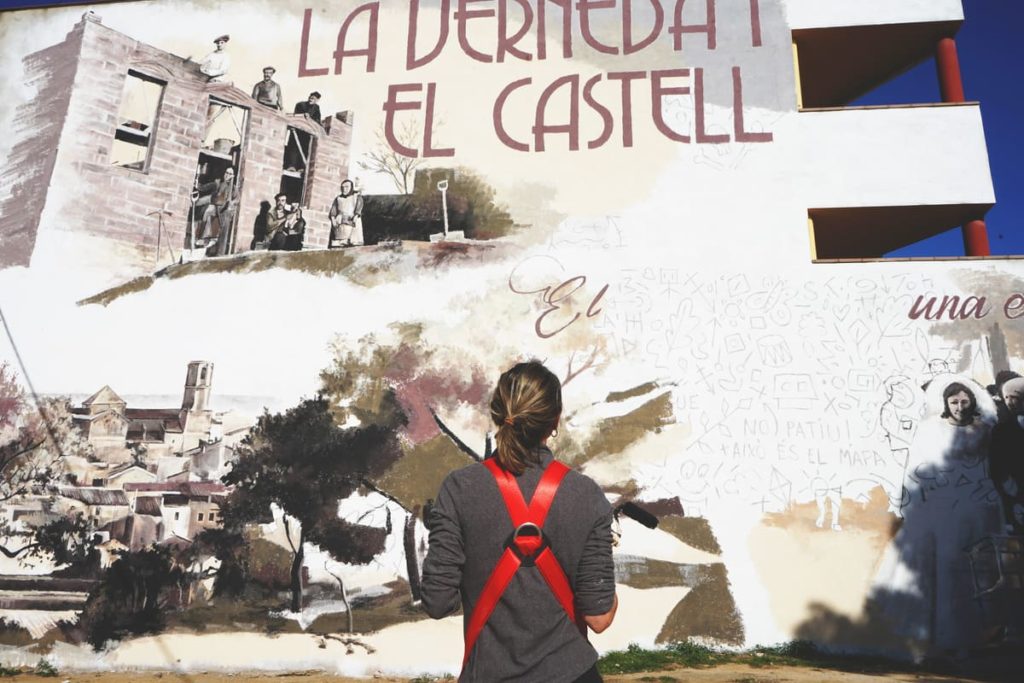
A party wall at Carrer de Lleida 20, between two working-class neighbourhoods shaped by the people who arrived in the 1950s and 1960s. The Igualada-born artist’s intervention is built from a composition of three archive images that carry the values and stories shared in a participatory session with local historian Joan Piña and the residents’ associations of both neighbourhoods.
In the video, the Dona i pagesia (Women and farming) mural from the MURMURS project. It sets out to give value to two things «that have perhaps not been very visible: women's role in farming and the importance of the land that feeds us». And a thought: mural painting, unlike other arts, «has an element that transforms public space, going beyond a decorative piece».
The video in text (abridged) (translated from Catalan)2 min 12 s
RebobinartMURMURS is a Rebobinart project looking for a method for working on and building a mural in the towns and cities of Catalonia. Different generations and different points of view are being brought together.
I think mural painting, unlike other arts, has an element that transforms public space and goes beyond a decorative piece, and that in some way it is a dialogue with the local context.
The town councilI'm really looking forward to seeing the result, because it can give a lot of visibility to the town's women farmers and to the rural world in general. We back this kind of mural basically because it is part of our history and because it gives value to two very important things that have perhaps not been very visible: women's role in farming and the importance of the land that feeds us.
We chose women and farming because I think we have to draw on our roots. These were women who were never made visible and who deserve their place, because history has not given it to them.
The artistI think it is also a remembrance of the mothers and grandmothers who worked here, perhaps more than we do and in harsher conditions.
Abridged version: direct quotes are kept; repetitions, overlapping speech and passages unrelated to the project are left out.
In the video, the MURMURS project in Malgrat de Mar: a mural created using a participatory method in the La Verneda and El Castell neighbourhoods. Rebobinart and the town council talk about giving spaces dignity, the sense of belonging, and their wish for the work to be a tribute to the people who built the neighbourhood.
Video transcript (translated from Catalan)1 min 54 s
RebobinartWorking with Malgrat de Mar and with this participatory method has been a challenge, but at the same time a confirmation that these projects work and that people have to be listened to and brought into the artistic creation too — in this case, of a mural.
The town councilThe purpose of launching this project is to give dignity to the spaces and to the town's different neighbourhoods. What that shows us is the sense of belonging the neighbourhoods have, and for us it is a source of pride.
Because, like it or not, it will be one more element, and it may even become an iconic element that enriches this heritage: it is a piece we have considered to be contemporary art. We want it to be a tribute to all the people who built the neighbourhood, a reminder for everyone.
So that those who pass by —not only tourists, but the rest of the neighbourhood and above all young people— can learn a little about this place's past. Because the people of this neighbourhood marked a before and an after here in Malgrat: they arrived and built where we are now.
Video transcript, edited for reading: repetitions and verbal fillers have been removed, the text has been punctuated and speakers are identified.
Supported by
MURMURS is supported by the European Union – NextGenerationEU, the Government of Spain, the Generalitat de Catalunya, the ICEC and Barcelona City Council, with the collaboration of Monto Pinturas and Montana Colors.
Would you like to bring a process like this to your town? Find out how we work with community and participatory urban art.


