

Participatory Mural in Les Corts




Barcelona

09.06.2015
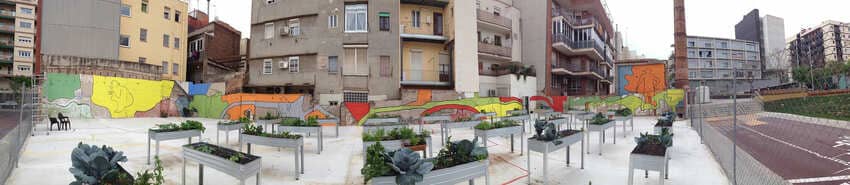
On 26 April, Rebobinart created a participatory mural with the community organisations of the Les Corts neighbourhood in Barcelona. The project began with a site handed over for urban allotments on Passatge Felip de Pau, where several local organisations work every day: Centre d’Higiene Mental de les Corts, Espai Jove Cardí, Associació Discapacitat Visual Catalunya, Associació de Veïns Les Corts Sud, Associació de Veïns Camp Nou, Centre Ocupacional Paideia and Taller Ocupacional Ariadna.
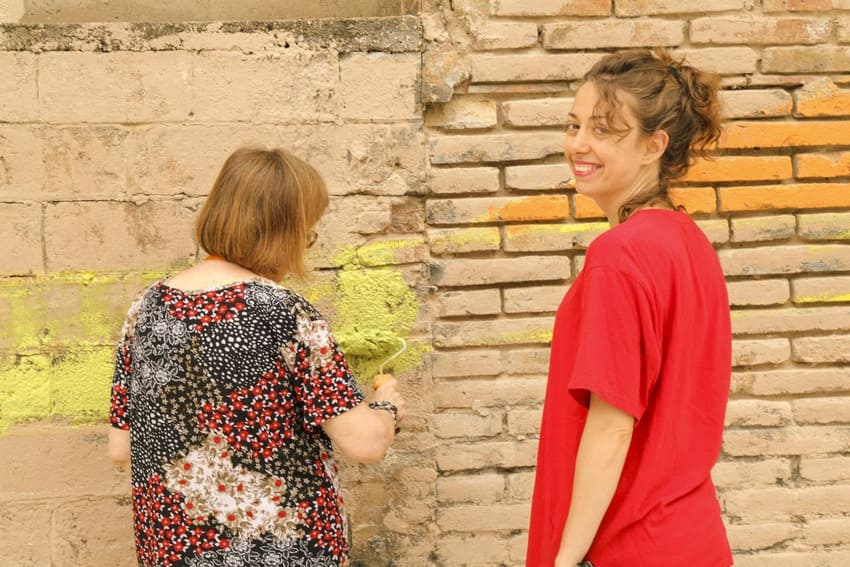
A participatory workshop was held beforehand, in which Natalia Morales — a Costa Rican artist who had recently settled in the city — drew out the collective imagination of everyone involved through a range of artistic techniques. The final design grew out of an exchange between the artist and the people who work in the allotments.
The project also involved the artist Octavi Serra, whose techniques made it possible for people with visual impairments to take part. Conflict mediator Elisenda Carbonell joined the process too, running a session in which workshop participants could put into a few key words what it meant to them to take part in a neighbourhood project like the allotments. Those words were finally written on the wall in Braille, using a plaster-based technique.
The intervention brought colour to the space and made the people who use it feel it is even more their own. The process built a spirit of collaboration among everyone who cares for the allotments, creating a positive atmosphere that will help strengthen their work in the neighbourhood.
In the video, the mural at the Les Corts urban allotments, made with local organisations —some of which work with groups at risk of exclusion. Rebobinart explains its method: «it isn't so much about the artist turning up with the design already done at home, but about capturing the community's imagination». The phrases from the workshop will also be written in braille.
The video in text (abridged) (translated from Catalan)5 min
The districtThis is a project of raised growing beds for urban allotments managed by neighbourhood organisations. The idea was to put this empty space to use: something collaborative around growing vegetables and greens.
It is an example of an action built on the collaboration of different organisations, all of them local, from around the Superilles area; with the added ingredient that some of them work with groups at some risk of exclusion.
At the allotmentsSo we all fill a watering can we have here, fill it with water, one bed each, and water it well.
RebobinartThe project we have in hand is one of many we take forward trying to involve the community in the artistic creation. It is no longer about the artist turning up with the design already done at home and painting what they like: we try to capture the community's imagination, how they feel in this space, and from there the artistic process is created with them.
Here we ran an activity with Natàlia: coming up with words or phrases that matter to them when they come to work these allotments. And interesting things came out. That things have to be watered so they grow. That they have to be cared for. Sharing, because working from sharing with others is when positive things appear. The hope that the fruit will grow. These are very powerful things.
Out of that brainstorm by the community and the associations came the design for the whole allotment area. Working from what the community tells us, from what they want, we develop the idea. And today the workshop was that: working on ideas, colours, concepts, some very abstract; but with that we already have more than enough material for a design.
Some phrases will also come out of this that Octavi will produce in braille, with the help of associations of people with visual impairments. And the mural across the whole wall will be finished with the help of the residents taking part in the public space that day. We will put a phrase in Catalan, in Spanish and in a language that can be read with the fingers: a line from The Little Prince, that what is essential is invisible to the eye. And beside it, in braille, all the words the people from the other associations wrote in this workshop.
The districtAround this space there is also all that painting they did, with the same philosophy: that they end up making the space their own, that when they see it they say «blimey, we did this together».
It is about recovering the neighbourhood spirit: having local organisations take the lead in these actions and work on them jointly —administration, organisations, facilities, services and the public—, aimed at improving the surroundings they live in.
RebobinartThe underlying idea is this: to involve people from the communities in artistic creation and to make them feel part of their city.
Abridged version: direct quotes are kept; repetitions, overlapping speech and passages unrelated to the project are left out.
In the video, the thinking behind the participatory mural in Les Corts: that the work could not be anywhere else and that it represents the people of that place. Associations of blind people and of mental health service users took part, as did children, «so that everyone's mark is left there».
Video transcript (translated from Catalan)1 min 6 s
The goal, in the end, is to see how muralism fits inside a city. The fact that artists arrive at a space, impose their work, and that this work has no context and is not rooted in a space means that work could be in any space at all, even in a gallery.
What we have to look for in muralism is that this mural could only be in one place and represents the people of that place.
Associations of blind people and of people with mental health conditions are taking part; the idea was a fairly all-encompassing one. And even today, now that we are working on all the paint base coats, we are working with children and they come to work too. It is a bit about that: including them so that everyone's mark is left there.
Video transcript, edited for reading: repetitions and verbal fillers have been removed, the text has been punctuated and speakers are identified.

