Interview
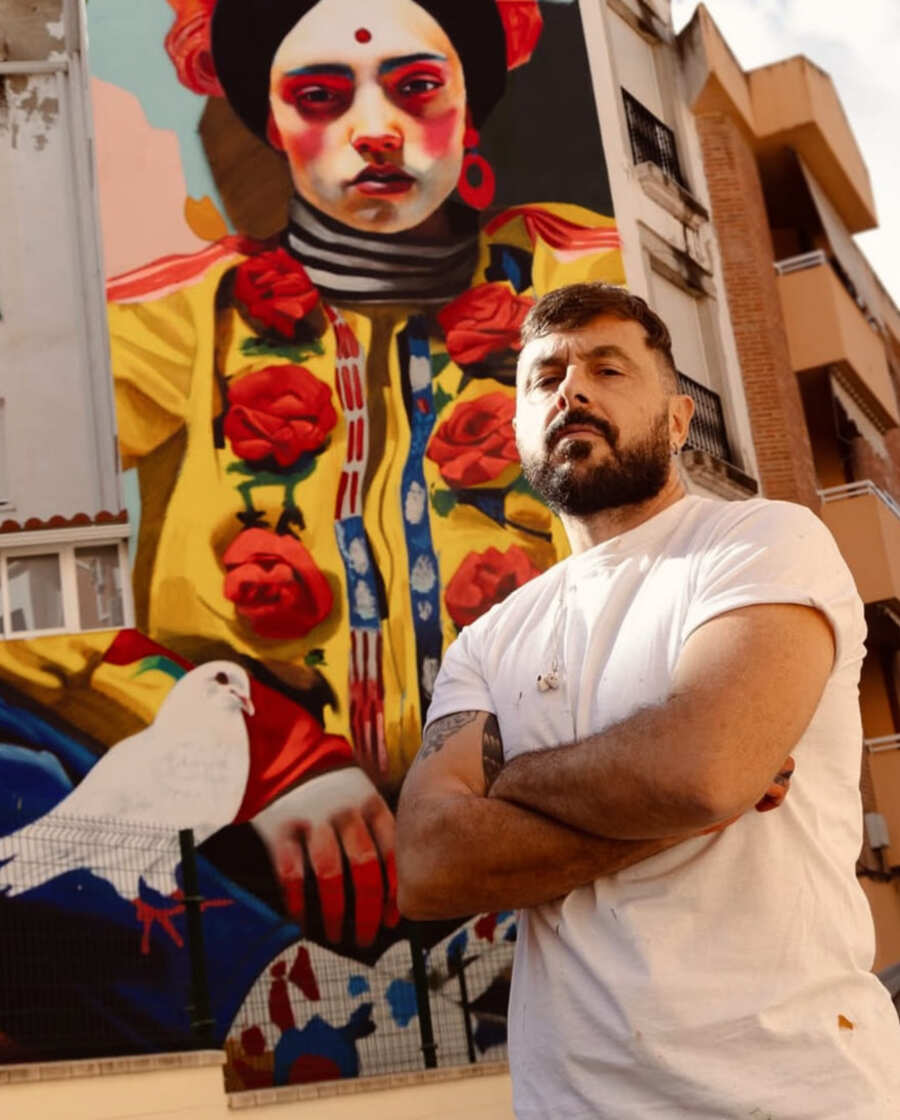 Dan Ferrer is a visual artist and muralist who transforms public space into a place of poetry, emotion, and shared storytelling. His work, characterized by figurative imagery and symbolism, turns intimate experiences into visually powerful compositions that resonate with universal emotions such as love, vulnerability, identity, and hope. Drawing on influences ranging from graffiti and flamenco to Mediterranean culture and classical painting, Ferrer has developed a distinctive visual language that is intense, sensitive, and deeply human, where each mural engages in dialogue with the architecture, the landscape, and the community.
Through a career spanning murals, exhibitions, and international projects across Europe, the United States, and Mexico, he has established himself as one of the distinctive voices in contemporary muralism.
You describe your style as “allegorical jazz,” combining realism and improvisation with universal symbols. How did this way of expressing yourself come about, and what are you trying to achieve through it?
My artistic language began to take shape in 2015, when I started looking for a way to translate poetry into figurative imagery. I was interested in portraying emotions and universal concepts — such as love, fear, or the passage of time — through ordinary people. That’s why the protagonists of many of my works have been my own family, especially my children and my wife.
That inspiration comes precisely from those everyday moments. By observing my children or spending time with them, I discover emotions and reflections that, although rooted in my personal experience, speak to something we all share. That is where the stories I tell begin.
In that first stage, my palette was dominated by greys, with small touches of blue inspired by the blue note of jazz and blues. It was from that relationship between improvisation, symbolism, and poetry that the concept of “allegorical jazz” was born.
However, my work underwent a profound shift in 2019, when my fourth son suffered a stroke just a few weeks after he was born. That experience completely transformed the way I understand life and, with it, the way I create. Paradoxically, even though my life and my family’s life became a path so hard I could never have imagined walking it, more colour began to appear in my painting. Faced with pain, helplessness, and suffering, I felt the need to speak about hope, energy, and the celebration of life. To understand that only the “here and now” truly matters. To embrace life despite the deepest pain, to smile even when it is not perfect, and to understand that instead of letting yourself sink, you have to row harder.
At the same time, I began reconnecting with my own roots: flamenco, Lorca’s poetry, the music of Falla and Granados, Spanish costumbrista painting, the street, the abstraction I had practised through graffiti in the past, the rough neighbourhoods where we grew up, and Mediterranean culture. Little by little, these elements started taking a central place in my work, to the point where I no longer feel that the term “allegorical jazz” fully defines what I do.
I’m still searching for poetry, but no longer through melancholy — now through the intensity of being alive. I paint to speak about love, fragility, strength, and identity. Ultimately, I use art to give a visual form to the way I feel.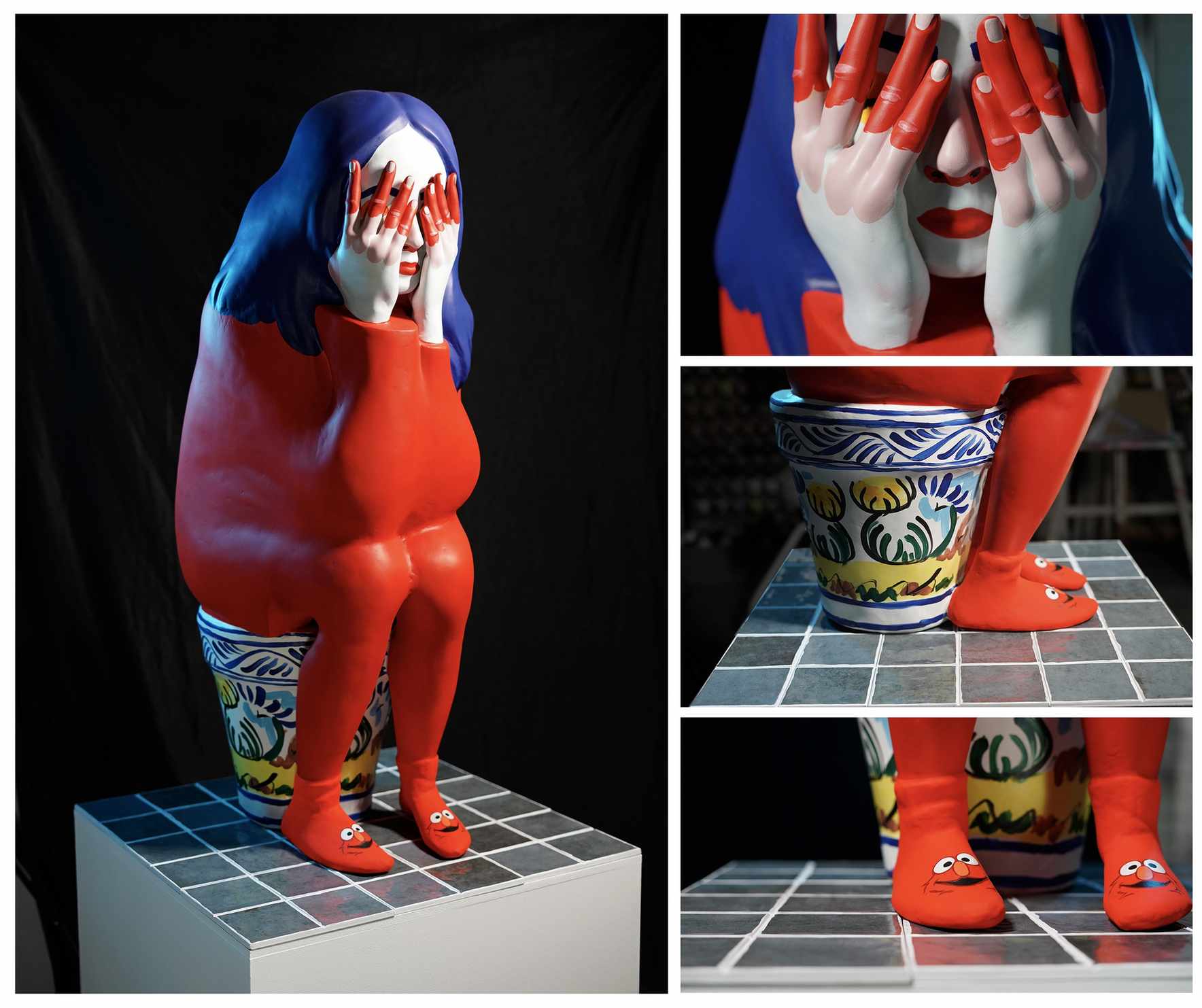
After leaving advertising in 2015, you decided to focus on your own art. What changed in the way you looked at things from that moment on?
Throughout my life, I’ve fought to make a living from my art. Because of the circumstances I grew up in, I received no support of any kind — apart from my friends, who constantly encouraged me — and from a very young age I used my creativity to get by. I went from being a teenager painting graffiti signs for local shops to being a young man meeting at Madrid’s KIO Towers to organise international artistic actions with Hugo Boss.
When I heard at home, “No one makes a living with a pencil,” I would answer myself: “Well, I bloody will.” I came from the grip of the neighbourhood, from absolute zero, and after years of fighting, I had managed to build a great deal of stability through work. I watched the studio I had created with my wife grow, and we threw ourselves into new projects for advertising agencies, production companies, events… with enormous ambition.
The problem was that the more the studio grew, the further we drifted from what we had always truly wanted to do: be artists. Real artists. Financially, we were doing incredibly well, but creatively we were exhausted. Our personal work was still there — we kept exhibiting and painting murals — but when we sat down to create, we felt we no longer had the mental or emotional space to do it properly.
There was one very specific moment that made me question everything. I was in the car looking at my eldest daughter, who was about five at the time, and I started wondering how she would remember me when she grew up. She might speak of me as a father who had given her stability and comfort, but who deep down was a sad person, disconnected from himself, someone who had not fulfilled his truest dream. That thought hit me hard.
My wife and I then decided to take a radical pause. We went to live in the heart of Manhattan for three months. Some people travel to India to reconnect with themselves… for us, New York was a way of looking at ourselves in the mirror, face to face, with everything we loved. We spent our days walking through museums like the Met and MoMA, visiting galleries in Chelsea, absorbing art, cinema, music, and the city itself. There, we understood something important: we didn’t want to dedicate our lives solely to producing for others, but to fully becoming the artists we had always wanted to be.
When we came back to Spain, we made a very drastic decision: to turn down all those clients and projects that were taking up almost our entire lives. And it wasn’t easy, because they were all very well-paid jobs for major international agencies. There was a huge sense of vertigo in saying “no” to something that gave you financial stability in order to bet on a personal body of work that you didn’t even know you’d be able to live from.
And yet, we felt it was the right path. Every important decision in our lives has been made out of love, and that one was too. We decided to invest our time in finding inspiration again, in recovering our voice, and in building a life more aligned with who we really were. It was a whole thing — picking up the phone and saying, “Don’t call me anymore.” Just from their voices, I could imagine their faces. They were stunned.
And although it was a risky decision, as people say, the universe seems to align when you’re honest, so that good things can happen in your life. And that’s why today I’m here, talking to you about my personal work.
 You often start from a powerful idea and then develop it until it becomes universal. How do you find that balance between the intimate and the collective?
 You often start from a powerful idea and then develop it until it becomes universal. How do you find that balance between the intimate and the collective?
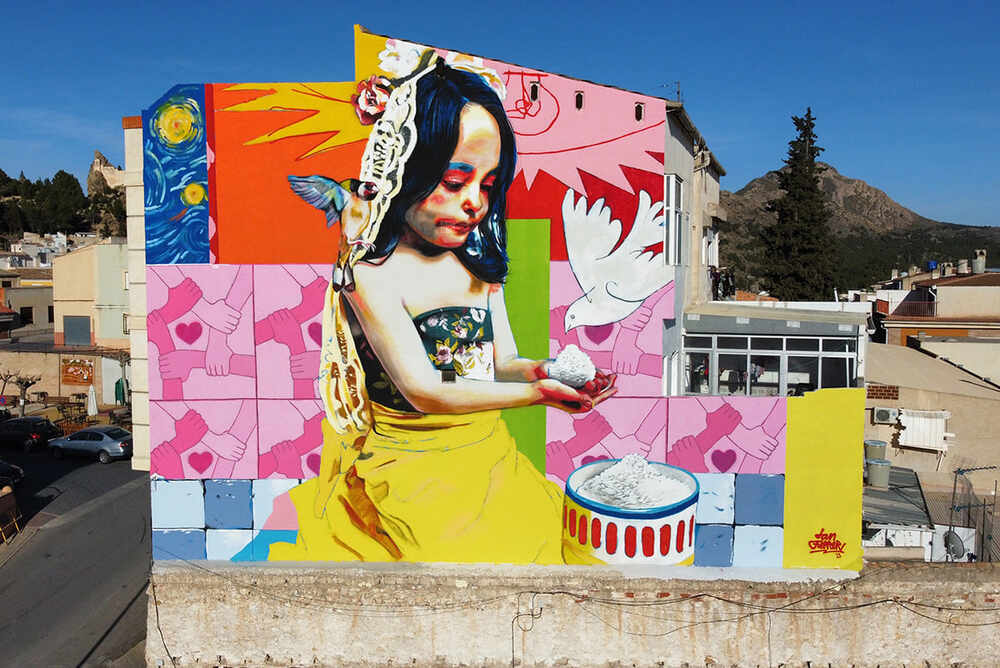
I think the balance between the intimate and the collective emerges quite naturally, because the most personal ideas are often also deeply universal. I find inspiration in very everyday moments: being with my family, talking with friends, or simply observing an apparently insignificant situation. In fact, some of my best ideas have come from completely ordinary scenes, like watching my daughter have a snack on a random Tuesday at seven in the evening.
From there, I start asking myself questions. At first, they are personal questions, connected to me, my children, or my immediate surroundings, but very quickly I realise that those emotions or reflections are not mine alone. The thought that runs through me while watching one of my children is probably the same one any father or mother is having somewhere else in the world.
What I do as an artist is refuse to let that thought disappear. I write it down, develop it, and look for a way to translate it into a visual language. I try to turn a fleeting emotion into an image capable of connecting with other people. That’s why I believe my works are born from deeply personal experiences, but speak about emotions we all share.
Works such as Rebuild Ourselves convey resilience and reconstruction. How do you bring those emotions into public space?
The way I translate those kinds of emotions into a visual expression comes from a very specific process. Everything usually begins with an idea or an emotion that appears in an everyday moment. From there, I make very quick line sketches, looking for compositions and poses that can convey exactly what I want to express.
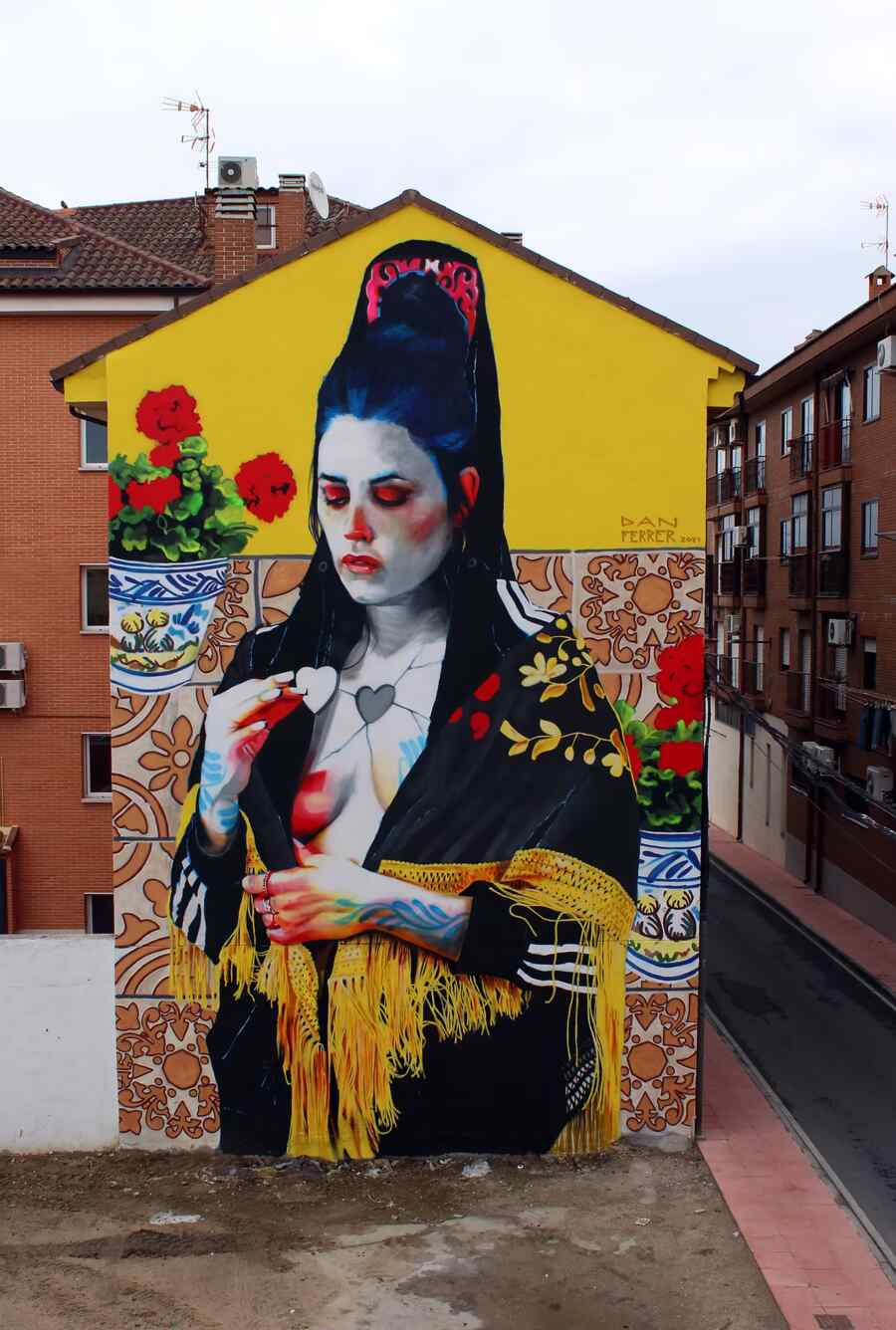
I’m very interested in giving the characters an almost theatrical presence, as if they were the frozen illustration of a poem or a suspended moment from a play. It’s not only the elements that appear in the image that matter, but also how the body, posture, or even a small gesture can express a very specific emotion.
After those first drawings, I do photo sessions with models — often my own family — in order to bring those ideas into the real world. At that stage, the process evolves a lot, because some things work on paper while others only appear when you see the body in motion. Sometimes I even accidentally discover an expression or a pose that perfectly captures the concept I had been looking for.
Afterwards, I work on the composition digitally, combining photography, digital painting, and montage, refining every detail. For me, the slightest tilt of the head or the smallest change in the gaze can completely transform what the work communicates.
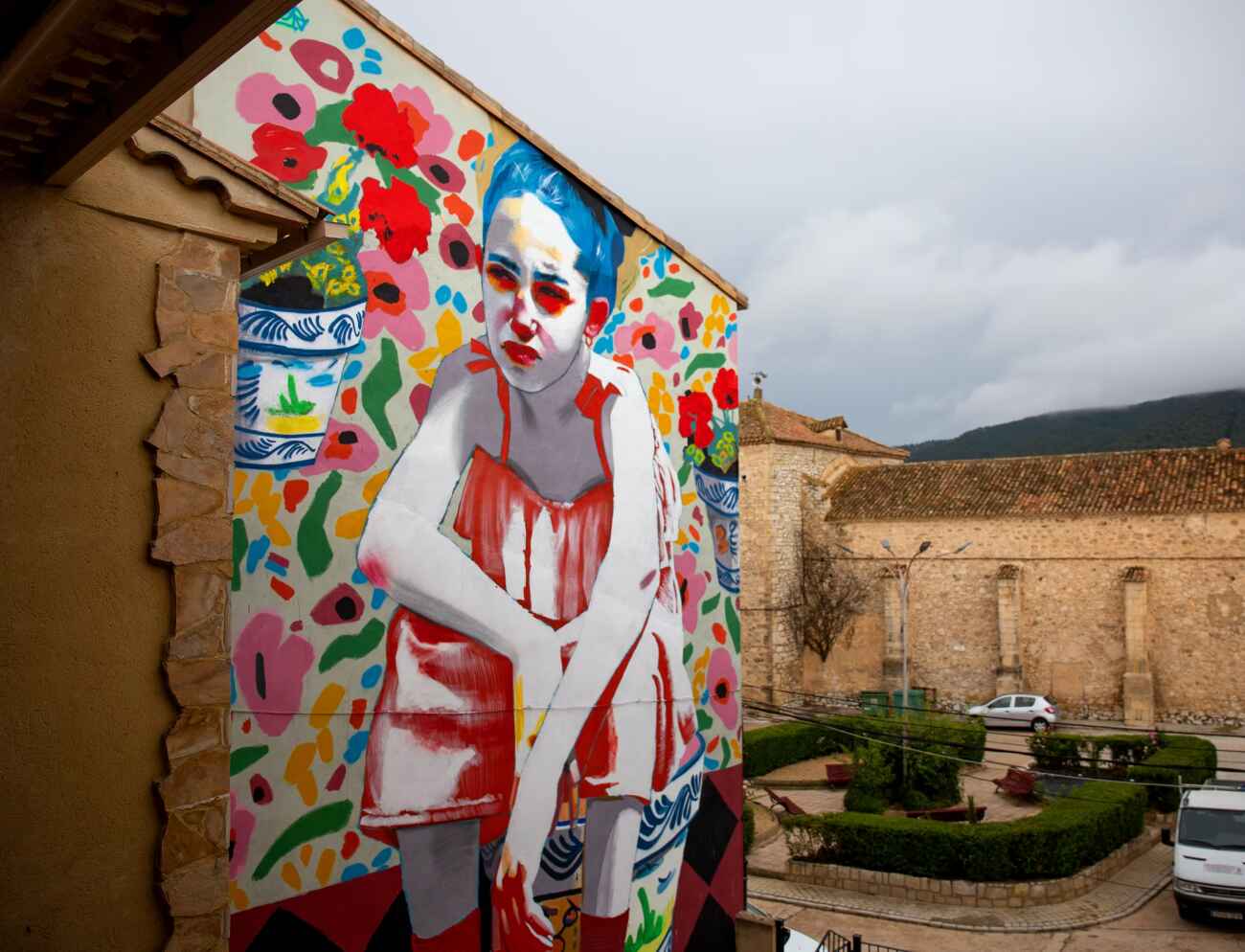
When I finally bring the piece into public space, the mural stops being just an image and begins to enter into dialogue with the architecture and its surroundings. In the street, you never work on a perfect canvas: there are windows, reliefs, cornices, volumes, and irregular formats. That’s why I adapt the entire composition to the building and reorganise the elements so the work can breathe with the space and become part of it. I think that integration is important, because public art should represent emotions, but it must also coexist with the everyday lives of the people who pass in front of it.
How did your proposal for Sant Andreu de la Barca within KROMATIC come about, and what values were you trying to convey?
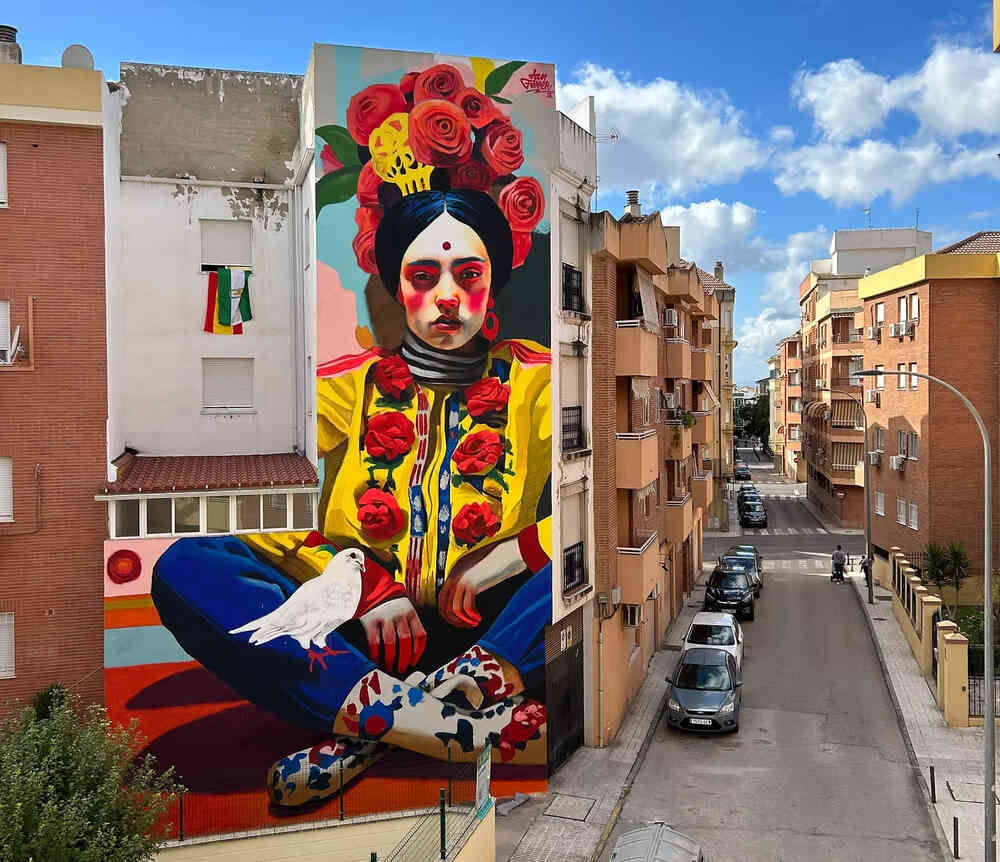 How did your proposal for Sant Andreu de la Barca within
The proposal for Sant Andreu de la Barca emerged from the life that coexists within the Aigüestoses building itself, a space that does not function only as a library, but as a true cultural meeting point. Reading, music, the local radio station, dance, and a range of creative activities all coexist there, so from the very beginning I felt a special responsibility toward this project.
My work often speaks about the importance of culture, creativity, and art as tools for personal growth, especially during childhood, so I felt the mural could not simply be decorative. I wanted to build an image that could convey that constant flow of learning, expression, and cultural life taking place inside the building.
From the start, I was also clear that I wanted to avoid clichés associated with culture. I wasn’t interested in making an obvious collage of books or musical notes, but rather in creating a kind of visual jungle — a more organic and emotional environment where all the elements could coexist within a composition full of movement.
That is why there are two characters who function as allegories of expression and learning. I also used the building’s architecture as an active part of the composition. The long horizontal windows, rather than being a problem, allowed me to conceal certain parts of the faces and highlight others, creating very specific visual focal points and playing with the way the viewer emotionally reconstructs the figures.
Within the work, there are elements linked to the space itself, such as books or music, but reinterpreted through my own visual language. The Spanish guitar, for example, plays an important role because my creative imagery is deeply connected to flamenco and to Spanish popular culture.
I was also interested in creating a contrast between the characters and the background. The figures convey calm, concentration, and reflection, because the building is also a place for study, listening, and learning. At the same time, the environment surrounding them is full of colour, shapes, and movement, representing all the creative energy that is constantly born within that space.
And of course, recurring elements from my work appear as well, such as vases and red carnations, which for me symbolise growth, rootedness, life, and transformation. In the end, the mural is really trying to speak about exactly that: how culture can become a place where people grow, express themselves, and build a collective identity.
What personal experience do you take away from this collective process with other artists and with the community?
The experience within KROMATIC was very positive, both professionally and personally. I think one of the keys lies in the festival’s direction. You can really tell when a project is led by someone with genuine experience in muralism and artistic production, as is the case with Marc, because everything runs smoothly. It’s not the typical event where you arrive, are handed some materials, and then the organisers disappear. Here there was a very attentive and efficient team, able to solve any unexpected issue quickly and naturally — and for those of us who work professionally in the street, that makes a huge difference.
It was also very enriching to spend time with other artists. Some were already friends or familiar faces, others were new, but these kinds of encounters always lead to very interesting conversations. Beyond painting itself, you end up sharing experiences, concerns, creative processes, or simply everyday moments.
On a human level, Sant Andreu de la Barca left me with a feeling of great warmth and good energy. I was really struck by the relationship between the people in the town and the way they interact in the street. There was a very special sense of closeness and naturalness. You could feel a very open and positive attitude toward art and toward what was happening in the streets.
In the end, when you feel that people are receiving the project with enthusiasm, and that the work you’re doing is becoming a meeting point, then of course the experience becomes much more exciting.
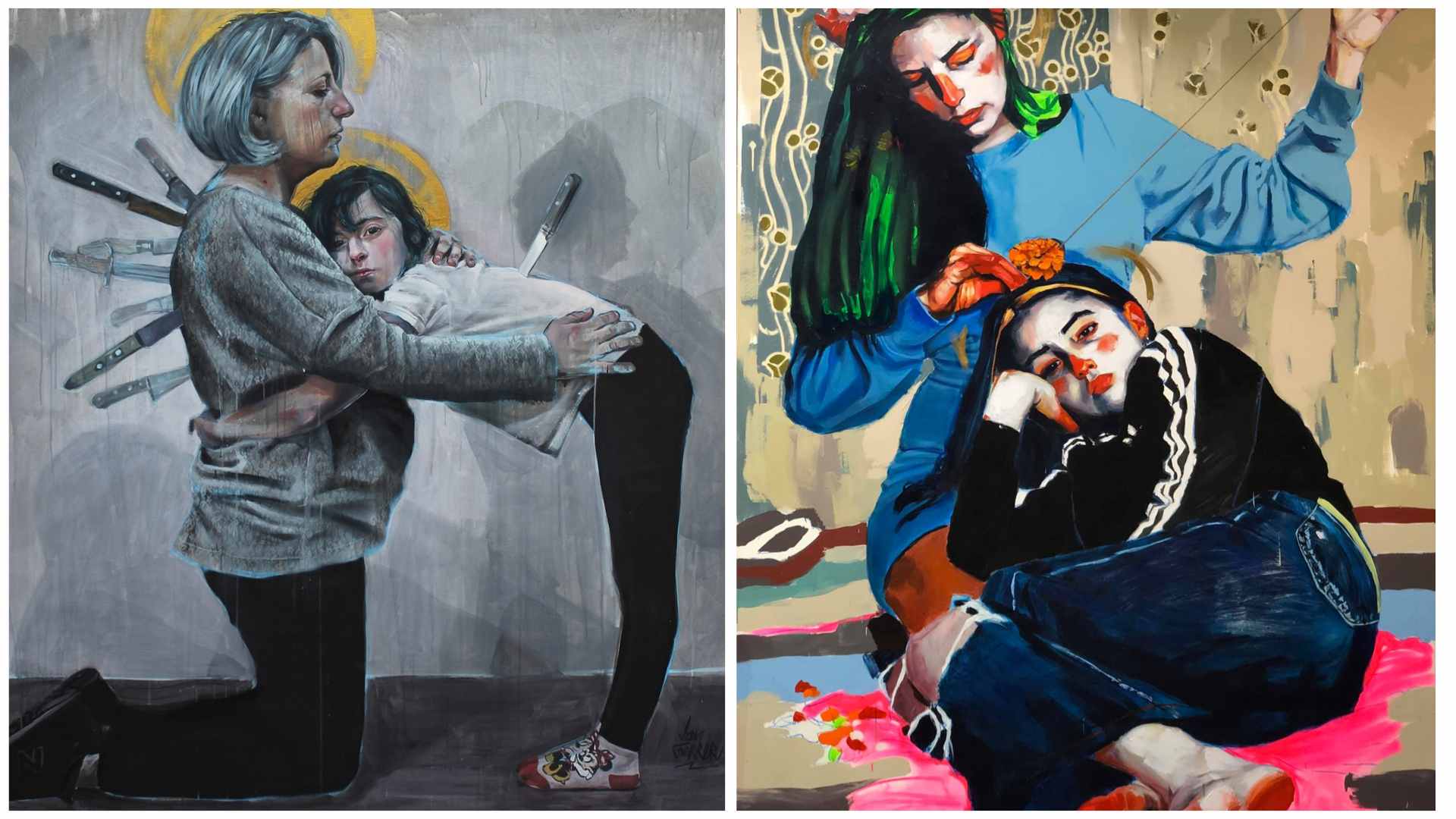
You’ve worked in cities across Europe, the United States, and Mexico. What differences have you found in the way people receive your work?
I think that, although I’ve worked in very different cultural contexts, the emotional reception of my work hasn’t actually been as different as one might expect. In the end, what I do speaks a lot about human emotions, bonds, identity, fragility, or hope — and that connects with people regardless of where they live. The poetic and emotional side of the works tends to be understood in a fairly universal way.
What I have noticed is that outside Spain, people very clearly perceive the Spanish cultural component in my work. My visual imagination is deeply influenced by flamenco, Mediterranean tradition, colour, emotional intensity, and certain cultural references that are part of who I am, and from the outside that is immediately noticeable.
In many places, especially in Europe and the United States, people have told me that my colours and the way I construct images feel very “Spanish” to them. They strongly associate that intense and luminous palette with ideas such as sunlight, energy, passion, or Mediterranean expressiveness. And it’s funny, because most of the time I’m not consciously trying to do that — it’s simply a natural part of the way I express myself.
It has also happened that, outside Spain, some people perceive the work as something exotic or deeply rooted in identity, but in a positive sense. I think that, in the end, what connects is precisely that: the fact that the work comes from something very authentic and culturally grounded, while at the same time speaking about emotions that anyone can recognise as their own.
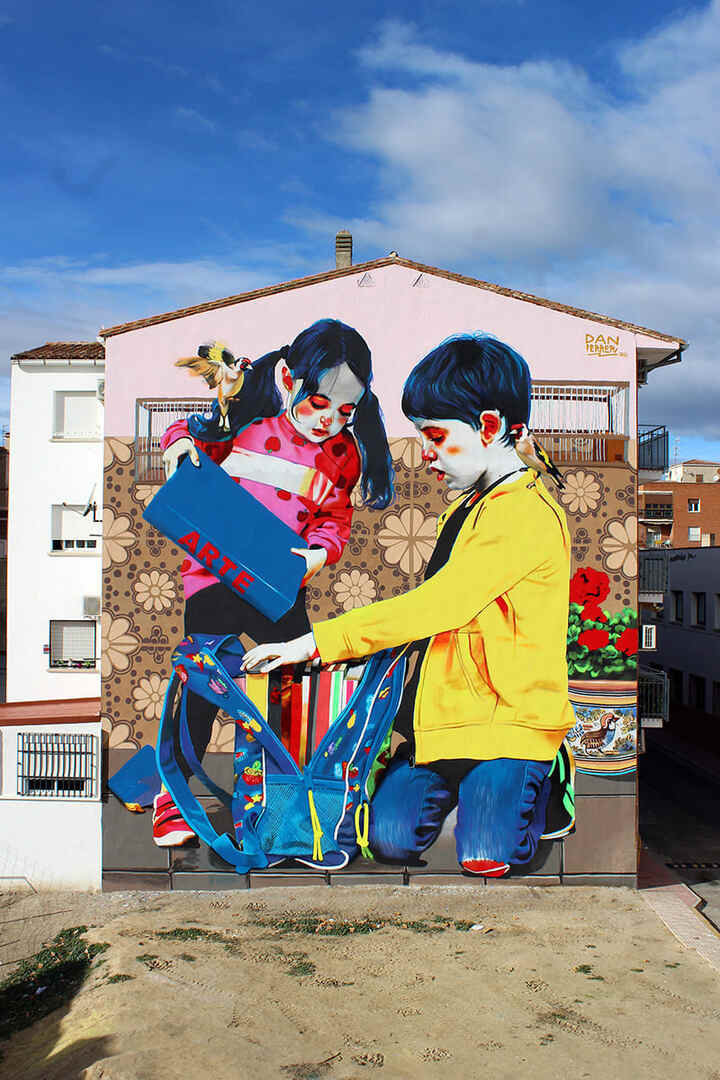
Of all the festivals you’ve taken part in, such as Fanzara or CI Urban Fest, which one do you remember most fondly, and why?
The truth is I could write an entire book answering this question, because practically every festival I’ve taken part in has given me very special experiences. Beyond the cities or the murals, what has always mattered most to me are the people. One thing that happens again and again is that I arrive at a festival thinking I’m going to work with other artists and organisers, and I end up leaving with friends.
Over time, you realise that these kinds of projects create very strong bonds. You share countless hours, conversations, problems, meals, exhaustion, and very intense moments. And even when months or years go by, those ties remain. I always feel a great deal of affection for the people I’ve met along the way.
To share a fun anecdote, during MIAU, Axel Void and I both had birthdays during those days. In the middle of one of the huge communal meals held in the village — with giant paellas and loads of people gathered together — they turned off the lights and came out with cakes to celebrate our birthdays. Afterwards, the festival director gave us napkins on which he had written: “good for one massage.” We thought it was just a joke… until a little later, when they took us to a flat where two actual massage therapists were waiting for us with their massage tables. It was one of those surreal and wonderful moments.
The last project I took part in — the Moniker residency in Tulum — uff… that was a whole extrasensory journey, so intense that it doesn’t fit into a few lines, so I’d rather point you toward my social media, where you can find out more about that incredible experience.
Urban art and social transformation
In what ways do you think murals can transform a neighbourhood or give identity to a space?
I believe that the mere presence of art is already transformative. It doesn’t matter whether it happens in a theatre, a museum, at a concert, or in front of a mural: when a person experiences an artistic expression, something happens inside them. Art can inspire you, move you, or raise questions that stay with you long after the experience itself has passed.
That’s why I believe public art has enormous value. It’s not the same to travel somewhere specific in search of art as it is to suddenly encounter it at your own doorstep, as part of your everyday life. It completely changes the relationship you have with space. Leaving your house and coming across a work capable of stimulating you emotionally does not have the same effect as walking among deteriorated walls or abandoned spaces. Art can even alter the way you face the rest of your day, because that first visual and emotional stimulus already puts your mind somewhere else.
Murals also end up becoming points of encounter and collective identity. Just as happens with a square, an iconic bar, or a monument, people gradually incorporate those works into their everyday imagination. The mural stops being something foreign and starts to feel like part of the neighbourhood and the community.
That, to me, is the most beautiful thing about urban art: even though the work is born from an artist’s vision, once it is out in the street it no longer belongs entirely to them. It becomes part of people’s lives and of the environment itself.
What weight do social messages carry for you in relation to pure aesthetics in your work?
For me, content and aesthetics are inseparable. I couldn’t say what percentage each one carries, but I do know that I could never create a work based purely on the visual if there wasn’t an idea, an emotion, or a story behind it driving me to make it. What truly moves me to paint is the content: the need to express something, to reflect on an emotion, or to convey a specific visual poetry. If that isn’t there, the creative process loses its meaning for me.
Years ago, I reached a kind of turning point where I felt that everything I made had to contain a real intention. I didn’t want to limit myself to producing images for their own sake; I needed each work to be speaking about something important to me, even if it did so in a symbolic way or remained open to different interpretations.
At the same time, aesthetics are also essential, because they are precisely the language through which I tell those stories. And when I talk about aesthetics, I’m not referring to simply “making something beautiful,” but to constructing a visual experience capable of conveying emotions without needing to explain them in words. For me, a work should not have to rely on a text beside it in order to function — although sometimes that can certainly add something. The painting, the composition, the colour, the bodies, the poses, and the expressions all have to be able to speak for themselves.
That is why I pay such close attention to all of those elements. A character’s posture, the direction of a gaze, bodily tension, the relationship between colours, or the balance of the composition all form part of the message just as much as the initial concept does. Everything has to push in the same emotional direction.
And although each person will ultimately interpret the work through their own experience — which is something that also interests me greatly — I do need there to be an emotional impact, for the image to provoke something. For it not to be merely something you look at, but something you feel. For me, that is where content and aesthetics stop being two separate things and become a single tool of expression.
Urban art depends largely on public or private funding. What model of support do you consider most sustainable for the future?
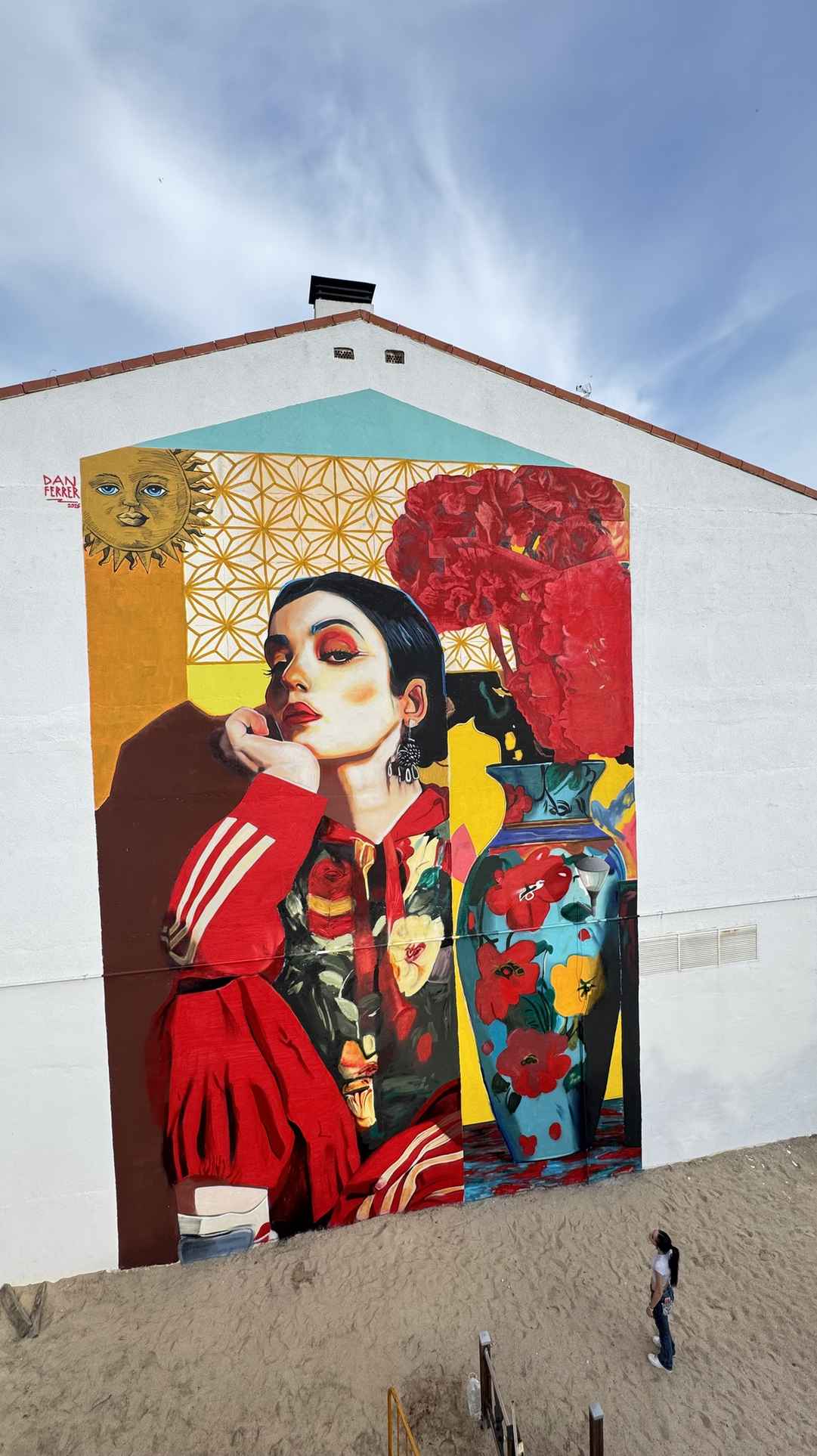 Urban art depends largely on public or private funding. What model of support do you consider most sustainable for the future?
I believe the future of urban art requires the coexistence of several support models: public, private, and also personal or self-funded. All three are important and fulfil different functions within the artistic ecosystem.
Public funding seems essential to me because art has a very important social role. In the same way that institutions invest in squares, parks, or infrastructure, they should also invest in bringing art and culture into people’s everyday environments. Public art transforms surroundings, inspires, creates identity, and brings creativity closer to people who might never set foot in a museum or gallery.
Private funding also plays a very valuable role. There are companies, foundations, and private initiatives driving incredible urban art projects, creating genuine open-air museums and developing curatorial work of the highest level. In the same way that private galleries bring contemporary art to the public from a different context, many private projects within muralism are helping to professionalise and expand the sector.
But I also think it is very important to defend a third path: self-funding and the personal initiative of artists themselves. All around the world, many people continue to intervene in public space by investing their own time, money, and energy, often outside institutional or commercial circuits. And that too is essential in keeping the language of urban art alive.
In fact, some of the boldest, freest, and most innovative proposals are often born precisely from there. When you work for large institutions or brands, you can run into limitations, conditions, or lines that cannot be crossed. By contrast, when an artist creates from a place of complete independence, they can allow themselves to experiment, make mistakes, break codes, or launch messages that perhaps no one would finance.
And I believe that freedom is essential if art is to keep evolving. Many of the works or movements that have truly pushed art forward were born from uncomfortable, free, and not particularly profitable positions. That’s why I think the ideal balance does not lie in choosing a single model, but in allowing all of them to coexist and complement one another.
How should the relationship between artists, institutions, producers, and sponsors be approached so that the essence of the message is not lost?
 How should the relationship between artists, institutions, producers, and sponsors be approached so that the essence of the message is not lost?
The relationship between artists, institutions, producers, and sponsors is a very complex balance, because each of those parties has different motivations and needs. Institutions seek to generate cultural or social impact, sponsors have specific interests, producers need the project to function on an organisational level, and artists try to protect their language and their voice. Getting all of that to coexist in a healthy way is not easy, but I believe that is precisely where the key lies: in finding a balance where every party is capable both of contributing and of yielding.
When that balance exists, projects usually work very well, and urban art can develop in a powerful and positive way within cities. I think part of the growth muralism has experienced in recent years comes precisely from the fact that, in many cases, those different mechanisms have learned how to understand one another.
That said, I also think it is important to accept that not every idea can exist within institutional or commercial structures. Sometimes an artist needs to say something or experiment in a way that simply does not fit within certain frameworks, whether because of content, aesthetics, or creative risk. And that is where independence comes into play.
That is why I believe it is essential for artists to continue having spaces of absolute freedom, even if that means working through self-funding or in smaller, less visible formats. The value of a work does not depend on its scale or on the amount of resources behind it. You can find giant murals that are technically impeccable but empty of content, and much smaller works capable of generating a far deeper emotional and cultural impact.
In the end, what matters is that art keeps moving forward and that artists can continue developing an authentic voice. And for that to happen, sometimes institutional support is needed, and at other times exactly the opposite is needed: total independence in order to take risks, break limits, and push artistic language into new territories.
In terms of the professionalisation of the sector, do you think urban artists are now receiving proper recognition and fair fees, or is there still a long way to go?
Yes, I do believe there has been a very significant professionalisation of the sector in recent years, and that recognition of urban art has changed enormously. There was a time when muralists were still viewed by some as “graffiti writers getting above themselves,” or as a minor discipline within contemporary art. That no longer makes sense. Urban art is now present in galleries, museums, institutions, media, and major international projects. It has become one of the most powerful and visible creative currents of our time.
In fact, I believe that the truly avant-garde gesture today has less to do with a specific pictorial style and more to do with the fact of having taken art out of traditional spaces and brought it directly into people’s everyday lives. For me, that democratisation of art is one of the most important cultural transformations of recent decades.
I also feel that after COVID there was an important shift within the sector. During the pandemic, a huge number of projects were put on hold, and I think that made both artists and organisers and institutions reflect on working conditions. Since then, I’ve noticed a greater professional awareness and, for example, it has become increasingly uncommon to find festivals expecting artists to work without offering fair fees. And that, to me, is a very positive step forward.
That said, although there is now greater recognition, there are still huge differences between countries in terms of budgets and financial conditions. The gap between what can be paid for a mural in Spain, in other European countries, or in the United States is still enormous. And I think that is closely related to the cultural and tax policies of each place. Countries that genuinely invest in art and make its development easier end up generating much stronger cultural industries.
In that sense, the United States is still playing in a different league when it comes to economics and investment in public art. But even so, I think the overall direction of the sector is positive, and there is growing awareness that behind a mural there is not just paint, but years of training, research, risk, and professional work.
If we look to the future, how do you imagine an economic system that would allow muralists to make a living from their work without losing creative freedom?
 If we look to the future, how do you imagine an economic system that would allow muralists to make a living from their work without losing creative freedom?
I believe that the challenge of finding an economic system that allows muralists to make a living from their work without losing creative freedom does not have a simple solution, because whenever there is financial investment, there are usually expectations from whoever is providing those resources. It is only natural that institutions, companies, or sponsors want some kind of cultural, social, or even reputational return. That is why the balance between funding and creative freedom will always be delicate.
That said, I think the first responsibility lies with the artists themselves. If a creator is not defending a voice of their own in their personal work, it will be difficult for them to claim creative freedom within funded projects. Artistic independence is not simply granted; it also has to be built and proven through a coherent body of work.
For me, it is essential that artists always maintain a space for research, risk, and personal exploration. Art only evolves when there are people willing to experiment, make mistakes, and follow their own paths, even when those paths are not the most profitable or the easiest to fund. That is why I believe that, even if an artist works within institutional or commercial circuits, they should never give up on developing in parallel those ideas that truly matter to them.
In an ideal scenario, the institutions, foundations, and organisations that support art should understand precisely the value of that freedom. In fact, models like this already exist: organisations that fund research and creative processes without imposing fixed outcomes. I would like to think that in the future, this kind of support will become increasingly common.
In the end, culture moves forward thanks to creative freedom. And the more capable we are of creating systems that allow artists to research, experiment, and express themselves without fear, the richer the artistic and cultural development of society as a whole will be.
Future and closing
What projects are you currently working on, and where would you like to take your work in the coming years?
This year I’m immersed in several projects that I’m especially excited about because they represent a natural evolution of my work. One of the most important has been the presentation of my first sculpture at Anderson Smith Gallery in Atlanta, alongside new canvas works in which I’m also exploring new directions. I’m feeling very motivated as I move into this sculptural discipline, and especially into large-scale public sculpture, which is becoming a line of work I’m very interested in developing over the coming years.
To present these works, I also organised a show at the gallery in the form of a highly sensory performance combining painting, poetry, fashion, and flamenco dance, which left attendees with the feeling of having gone on one hell of a trip inside my head — something we all enjoyed immensely.
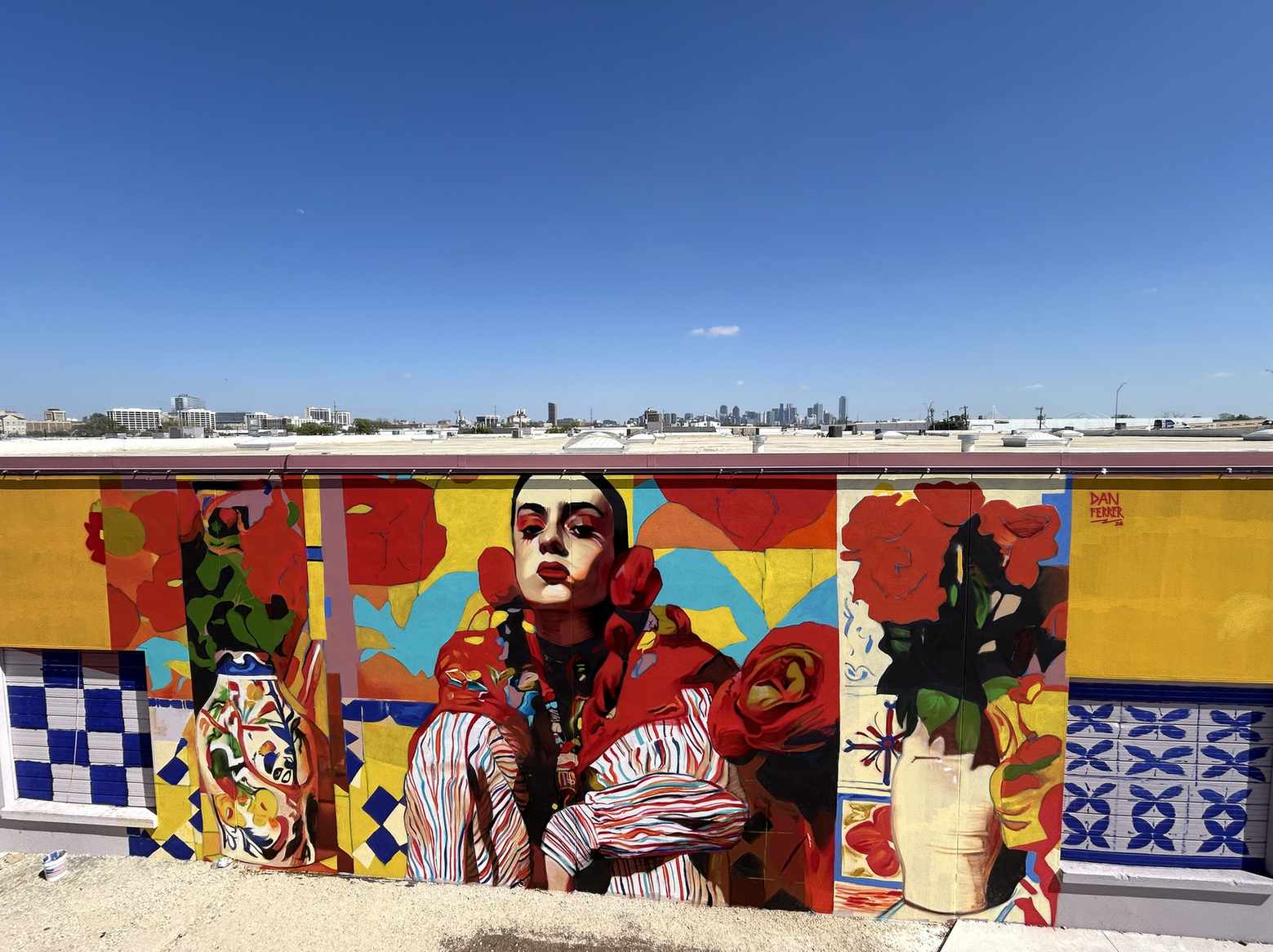
I also recently completed my first large-scale mural in the United States, in the city of Dallas, as part of the Art Docks project. It was an extraordinary experience and, on top of that, it opened up new opportunities and conversations that have me feeling very motivated about the future of my work in that country.
On another front, I’ve just returned from an artist residency organised by the Moniker Foundation in Tulum, Mexico. It was ten days of living, creating, and connecting with nature in a very special environment. There, I developed a highly singular work that intervened in the entire home of a local Maya family, a project I was able to carry out thanks to the support and trust of Tina Ziegler, director of the foundation. It was one of those experiences that reminds you why you make art in the first place.
In the coming months, I’ll also be taking part in several international festivals that have not yet been officially announced, so I still can’t share details, but they will gradually appear through my social media.
One project I can already mention, now that it has been made public, is my participation in Waterford Walls in Ireland, where I’ll be creating a large-scale work thanks to the support of the Cervantes Institute in Dublin and the festival itself.
And beyond the specific projects, I feel I’m going through a very stimulating moment of growth. I’m developing new works in the studio, exploring different formats, and expanding the limits of my own visual language. If I think about the coming years, I’d like to carry out the collaborations that are still only conversations today, keep meeting new people and discovering new countries, and embrace everything that is still to come. Not knowing what will happen — that uncertainty — is one of the most exciting parts of what we do.
Could you sum up your trajectory or artistic purpose in a single sentence or idea?
At heart, I use art as my own psychologist. I paint in order to understand life and to understand myself. And I hope that, by sharing that process, I can also accompany other people through theirs.