

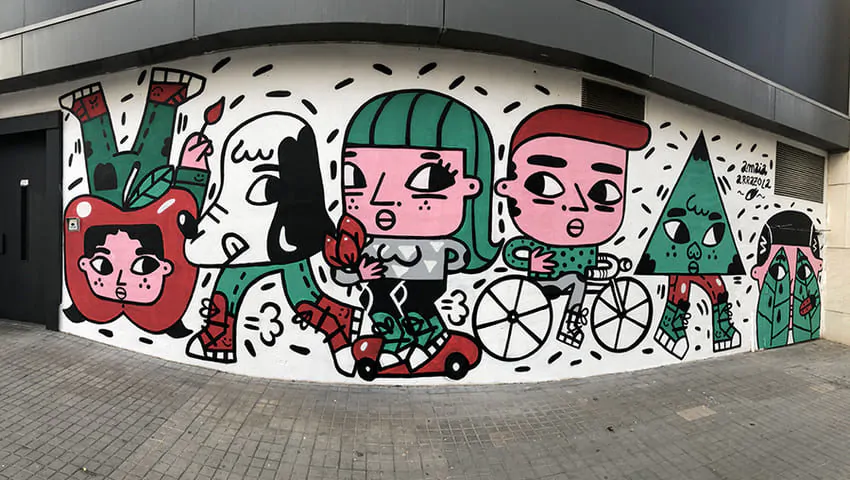
Amaia Arrazola was born in 1984 in Vitoria, in the Basque Country. She studied Advertising and Public Relations at the Complutense University. After finishing her studies she spent several years working as an art director and illustrator at an advertising agency in Madrid, but in 2010 she decided to move to Barcelona and devote herself to illustration. That is when she began to get into muralism, eventually bringing her work to large-format walls.
Over the course of her career as an artist she has published several books, such as Wabi Sabi: un mes en Japón and El Futuro es Femenino, and has worked for well-known brands such as Coca-Cola, Nike and Movistar. Amaia has travelled the world painting and exhibiting her murals in places like Rabat, Japan, Romania, Miami and Paris.

You started out as an art director at an advertising agency in Madrid and decided to leave it all and move to Barcelona to pursue a career as an illustrator. What prompted that turn in your artistic career?
Looking back now, I think there was a high percentage of recklessness in it. I simply got tired. At the agency I spent all day in an office and creatively I was not satisfied at all. I was missing everything: getting my hands dirty, managing my own time, more freedom. At that time the banks still had social programmes and I took advantage of one of them, which gave me a grant to move to Barcelona and study a master’s in design. I was simply looking for a change of life. I did not think I would end up making a living from illustration… but the stars aligned. So that’s it: a lot of work and a bit of planetary alignment.
Illustration, large-format murals, ceramics, sculptures… what does working across multiple formats give you?
Freedom. For me it is all part of one thing, it is all me. I think it reflects my personality. I am restless, I like trying new things, and having a foot in different formats means I can keep having fun, jumping from one to another and enriching them all at the same time. I don’t separate them; they are all part of Amaia.
It has also saved me professionally and financially on several occasions. These last two years, when I have not been able to paint murals (motherhood, pandemic), I have made the most of indoor work and thrown myself into books and the odd advertising project that came my way. Then I have periods when I string mural projects together and forget what it is like to sit at a drawing table.
Even though every piece is different, you have very characteristic strokes that are part of your artistic identity. Which sources of inspiration have shaped the evolution of your style so far?
Style is something people ask about a lot, but being so close to my own work I am not aware of it. I am too close. Then again, style is nothing more than what you have in your head and what your hand allows you to do, so obviously my “style” is the sum of my references. And what are they? The people who have accompanied me through life, and artist and illustrator friends I have watched evolve. Then there are all my experiences, which also shape me. From small things like conversations at the supermarket or on the metro to the bombshell of having a daughter. My daughter’s view of life inspires me. Having her close and doing things for her, so that she has fun, gets my brain working.
Creating on the street involves a very different format and context from the studio and from illustration on paper. What led you to paint your first mural on the street?
I have no idea. Looking back, I think it was the fact of not having done it before. The question of whether I would be able to, the butterflies in my stomach. I had seen enough of the drawing table and the computer and wanted to do something different. To leave my comfort zone.
What challenges have you faced working on murals, and what attracts you most about creating in public space?
When you paint on the street, things ALWAYS happen. Anyone who has ever put a brushstroke on a wall in public space knows that. People come out to tell you they don’t like your work, ask whether it is legal, whether you have permission, say they don’t agree. There are also people who like it, of course. You have to learn to concentrate despite the conditions. It might rain, it might be very cold or very hot. You choose a colour and a different one arrives. The lift breaks down, the ladder breaks, who knows. As I say, you are exposed to many factors you no longer control as much as you would in smaller-scale work.
And then there is the fact that what you are making is not only yours. By “invading” public space it becomes everyone’s, and when you choose what to paint you have to bear that in mind. It will become part of people’s lives. What do I want to leave here for them?
Many of your creations are full of female figures. What does feminism represent in your work?
They are two different things. I draw female figures because I am a woman and my body is what I know best.
Feminism, for me, is everything. It is not a choice, it is a way of seeing life, of understanding it… I am looking for my place in the world, as a woman, as a human being. And through feminism, through feminist literature and feminist cinema, I have understood many things. But in my view, anyone who is in favour of respecting human rights should be a feminist, and the question should not be why you paint feminist murals but how it is possible that you don’t include this subject, not in your work, but in your everyday life.
In fact, in 2014 you painted a mural for International Women’s Day together with Orne Cabrita at the La Farinera del Clot cultural centre, and in 2015 another one against gender violence with Maria de Reskate in Les Corts. Do you feel your work has ever been affected by the fact of being a woman?
Of course. For better and for worse, our work is the result of who we are. From general things like the choice of subject when painting, the inspirations that mark me, or being selected for a festival because I am a woman (and there has to be a female quota), to more individual or personal things like not being able to work at full speed because I have my period, or having to stop every three hours because I am a mother and have to breastfeed my daughter every two hours.
In 2020 you released “El Meteorito”, your new graphic novel, in which you show a very personal and visceral view of what becoming a mother has meant for you. How has motherhood affected your artistic career?
It has cut right through it and split it in two. There was a moment when I thought I would never paint again, but look, life goes on. And it is true that the meteorite (my daughter) wiped out a lot of what was there before, but it is also true that a lot of life has been born since. Different from before, but life after all. 
We often hear the phrase “being a mother is the best thing that can happen to you”. In the book you go further and highlight the ambivalence of your experience, both emotionally and professionally. Do we need more voices that unmask and expose the less pleasant sides of motherhood?
I think more and more female voices are being heard talking about real motherhood. There are more and more books about this famous ambivalence: Jane Lazarre and her “The Mother Knot”, or Esther Vivas and “Mamá desobediente”. But the answer is yes. Of course many women experience motherhood in a more “pleasant” way than others, but we must not forget that motherhood is a bombshell, that it leaves many of us somewhat split in half, and that narrating it, saying it out loud, is not only necessary but healing.
The book has in fact stirred some controversy on social media. Why do you think some people felt offended by your account? In what way do you think it departs from the patriarchal view of motherhood?
Because motherhood is another aspect of life that has been entirely associated with the feminine, and the feminine has always been in the background, silent, in the private sphere. When you bring up such important subjects, such “backbone of humanity” subjects, and turn them upside down, “a lot of blisters come up” and many masculinities feel hurt. (I must say this is not entirely fair, because I was also attacked by women. I suppose in the end machismo and patriarchy have very long arms and still touch and direct the mentality and way of thinking of many people. Men and women.) But you shouldn’t pay attention. You have to keep to your own path and not let yourself be distracted by what others say, least of all on Twitter.


