

The Ministry of Culture recognises Wallspot as one of the best cultural and creative industries projects



In the video, the Spanish Ministry of Culture's awards for the best cultural and creative industry projects, where Wallspot was one of the winners. Below, Marc Garcia's contribution: how the project started from a fine, why Barcelona had no legal alternative for painting, and how walls that are erased every day ended up working in twenty countries.
The video in text (abridged) (translated from Spanish)1 h 24 min
Let me start by explaining where we come from. The truth is I don't come from the art world or the cultural world: I come from an advertising agency. One day my brother, who worked with me, asked me for a pay rise, because he had fines to pay for painting in the street. And I told him: I'm not going to raise your salary; what I am going to do is make it possible for you to paint in the street. And a whole world opens up, because you find that public space is very restricted.
In the case of Barcelona we had an urban landscape bylaw that banned any kind of painting in the street, and no alternative had been created. Wallspot is pretty much that: this year we turn ten and we are the alternative. Rather than censoring and simply saying «you can't», there will be spaces where people can express themselves freely.
What we have managed to create is walls that are infinite. They are infinite because they are painted every day and the works are erased every day, and that generates constant interest. We have walls in Barcelona, but we are in twenty countries, because other cities asked us to open up this software: a mobile app and a website that let you find a wall in your city, select it, request a permit, paint and upload the photograph. And it creates a space for dialogue, a space of freedom and a space that manages itself, because the works that are there today most likely will not be there next week.
The platform is not only artists: there are sociologists and architects. What we have looked at is how public space is looked at. If you only look at it from the artistic side, that is where we found the conflict, because the artistic side is not looking for sustainability or for a project as such, and in the end that produced the conflict of an entire city painted over. By bringing in sociologists who help us talk to residents' associations and to owners, and to understand how the level of acceptance will evolve. And architecturally too: in Europe we have architecture that has to be protected. Running this project in Barcelona or Madrid is not the same as running it in the United States, where buildings can be knocked down and put back up.
Offering legal spaces in the public realm has brought in a great many creators who would never have come in, because in the end illegality was exclusive to whoever dared to paint illegally in the street. When you offer legal walls to everyone, illustrators, designers and advertising people can come in… and a single vision turns into all of them. I think that was the most groundbreaking part.
The idea is to keep helping to build this talent pool. Festivals are being created and large-format projects are going out to tender, and for that we need artists: either we create spaces where new generations of trained artists can emerge, or we will end up with elite cities where four artists paint every city, with no differentiation between them and no turnover. When we talk to architects, above all at Barcelona City Council, we talk about not mortgaging spaces with one work by one artist. The project has gone by different names —Persianes Lliures, Murs Lliures and finally Wallspot— and it has to keep transforming. We have to pause the work and look at how the surroundings are behaving, because sometimes you are inside the tunnel and cannot see beyond what you yourself are doing. If you stay fixed, you turn into a sculpture.
Video by Espacio Fundación Telefónica Madrid. Abridged version: direct quotes are kept; repetitions, overlapping speech and passages unrelated to the project are left out.
Madrid
08.11.2022


- Wallspot is Rebobinart’s initial project to technologically manage the free walls of different cities in order to be able to paint legally and safely.
- The initiative received an award at a gala event organised by the Subdirección General de Promoción de Industrias Culturales at the Espacio Fundación Telefónica in Madrid.
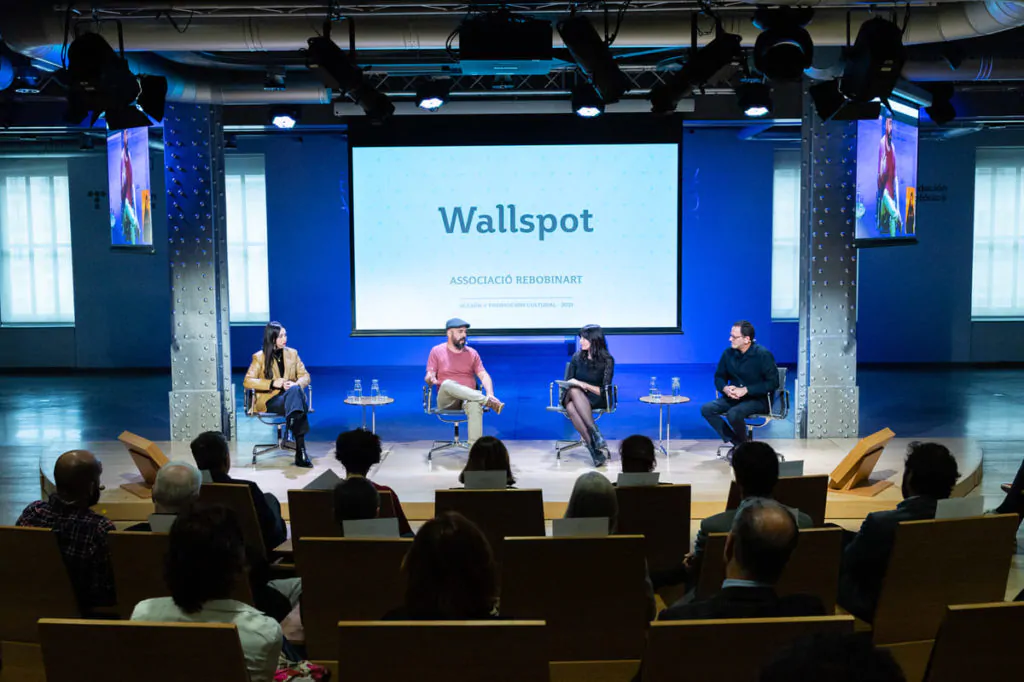
In November 2022, in Madrid, the Ministerio de Cultura y Deporte recognised Wallspot as one of the best cultural and creative industries projects of 2021. The photo shows the round table on stage with the screen projecting «Wallspot · Associació Rebobinart» in front of the seated audience.
In a round table with Proyecto Ballena and the Trovam Proweekend fair, Rebobinart’s director and founder, Marc Garcia, explained how Wallspot grew out of the management of Murs Lliures and how it now runs more than 90 free walls across some twenty cities. The full story is at Wallspot 2012-2024.

